
Innovation Isn’t One Team’s Job Anymore: How R&D, IT, and Innovation Teams Can Finally Work Together
Who this post is for: R&D leaders, CIOs and IT leaders, and Chief Innovation Officers who each own a piece of how their organization adopts new technology — and keep running the same work in parallel instead of together.
For most of the history of corporate innovation, someone owned it. There was an innovation team, or an R&D function, or a digital-transformation office, and the mandate lived there. Everyone else’s job was to execute what that team handed down.
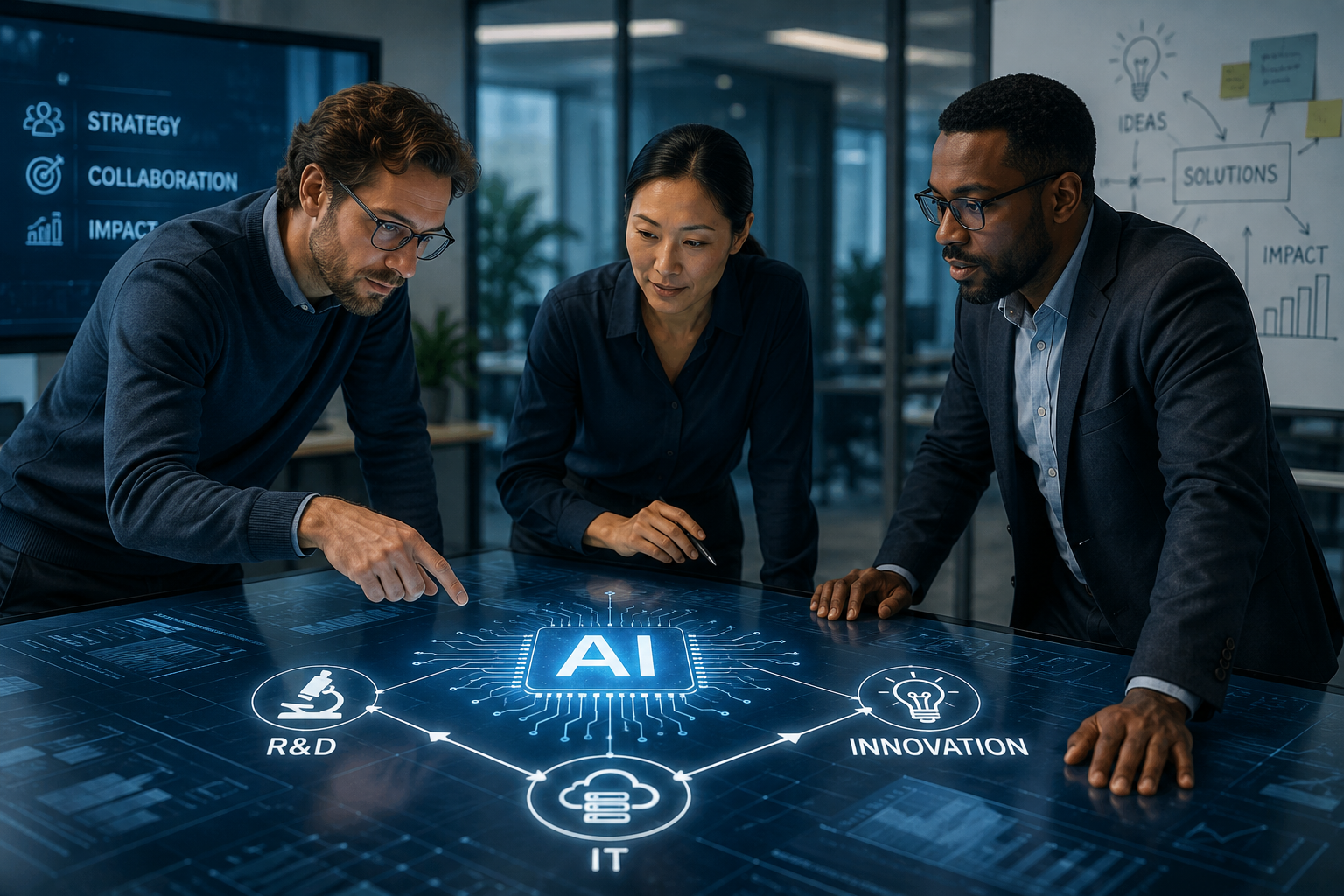
That model is quietly breaking, and the reason is simple: technology adoption is now everyone’s problem. R&D is evaluating AI for product development and discovery. IT is fielding a flood of requests to adopt AI tools and fielding the security questions that come with them. The innovation team is still chartered to find and pilot what’s next. All three are, in effect, doing versions of the same work — scouting technologies, evaluating vendors, running pilots — and in most organizations they’re doing it in three separate systems, with three separate processes, invisible to each other.
The cost of that fragmentation is enormous and mostly uncounted. The same vendor gets evaluated three times by three teams. A pilot R&D ran last year gets proposed again by innovation, because nobody captured the outcome anywhere the others could see. IT blocks a tool the innovation team spent a quarter championing, because IT was never in the conversation until the end. The organization has more people than ever working on innovation and less to show for it, because the work is scattered.
This post is about what’s actually changing in the space — drawn from a Traction AI Trend Report on where enterprise innovation management is heading — what it means for each of these three teams, and the one organizing principle that lets them finally work as one.
Before the argument, a look at where the market is heading. Alongside Company Snapshots, Traction AI generates category-level Trend Reports — here is a condensed signal of what it surfaces for AI in enterprise innovation management in 2026:
What the Trends Mean for Each Team
The trends above land differently on each of the three teams that now share the innovation mandate. Understanding what’s changing for each is the first step to getting them aligned.
For R&D: scouting and evaluation are becoming AI-assisted and continuous
R&D has always scouted external technology — but historically as a periodic, manual, relationship-driven effort. The shift toward AI-powered scouting and evaluation changes the economics: instead of an analyst spending weeks compiling a landscape, AI can surface and assess candidate technologies continuously, against a specific problem, across a far larger universe than any individual could track. For R&D, this means the question is moving from “who do we happen to know in this space?” to “what does a comprehensive, current scan of this space actually show?” The teams that adopt AI-assisted scouting stop missing the company three doors down from the one they found.
What R&D needs from a shared system: the ability to scout and evaluate against real technical and feasibility criteria, with the evaluation captured so it doesn’t evaporate when the project moves on.
For IT: the gatekeeper is becoming a partner — if the process lets it
IT is under more pressure than any of the three. It’s absorbing a surge of AI-tool requests, it owns the security and compliance exposure those tools create, and it’s increasingly expected to be an enabler of innovation rather than the office that says no. The trend toward integrated, governed innovation workflows — and toward documented, traceable evaluation for regulatory and security reasons — is really a trend toward bringing IT into the process earlier, as a partner who shapes what “approvable” looks like, rather than a gate at the end that rejects finished deals.
What IT needs from a shared system: visibility into what’s being evaluated before it arrives at security review, the security and compliance questions surfaced up front, and a documented, auditable decision trail.
For Innovation: the job is shifting from generating ideas to orchestrating a pipeline
The innovation team’s role is maturing. The early model — run ideation campaigns, collect big ideas, hope some stick — is giving way to something more operational: running a continuous pipeline from problem to pilot to scaled outcome, with portfolio visibility across all of it. The trends toward innovation accounting, portfolio management, and measurable ROI reflect a function being held to a higher standard: not “how many ideas did we collect?” but “what moved, what did it cost, and what did it return?”
What innovation needs from a shared system: a single pipeline view across every active effort, a clean path from validated opportunity into governed pilots, and the institutional memory to prove outcomes.
The Problem With Three Teams, Three Systems
Here’s the trap. Each team, responding sensibly to these trends, adopts its own tooling and tightens its own process. R&D gets a scouting tool. IT builds an intake-and-review workflow. Innovation runs an ideation platform. Each is individually reasonable. Together they guarantee the fragmentation gets worse, because now there are three sophisticated systems that still don’t talk to each other.
The teams don’t align by being told to collaborate. Mandated collaboration between groups that work in different systems, on different inputs, toward different metrics, produces meetings, not alignment. They align when they’re working the same pipeline, from the same inputs. And that raises the real question: what shared input could possibly unite a technical R&D evaluation, an IT security review, and an innovation pilot?
The answer is the thing all three are ultimately in service of, and the thing most organizations capture least well: real, validated problems — the pain points and ideas of the people doing the work.
The Unifier: Start From Real Pain Points, Not Mandates
Most innovation effort starts from the top: a strategic theme, an executive’s priority, a “we should be doing something with AI” directive. That top-down input is exactly what doesn’t align R&D, IT, and innovation — because it’s abstract, it’s not owned by any of them, and each team interprets it differently.
Flip the starting point. Begin instead from the bottom: the specific, validated friction that employees experience in their actual work, and the ideas they have about how technology could help. A pain point is concrete, it’s real by definition, and — crucially — it’s a shared input that gives each of the three teams a clear, non-overlapping role:
- An employee or team reports a real pain point or idea — a process that’s broken, a capability they wish they had, a friction that slows them down.
- It’s captured and clustered, so convergent problems surface as priorities rather than scattered tickets, and duplication is caught automatically.
- Innovation routes and owns the pipeline, turning the validated problem into a defined opportunity.
- R&D evaluates feasibility and the technical fit of candidate solutions.
- IT scouts and vets the technology, bringing the security and compliance lens in from the start rather than at the end.
- The strongest solution moves into a governed pilot, measured against the baseline the original pain point established.
Now the three teams aren’t three parallel processes. They’re three roles in one pipeline, working from the same validated input toward the same measured outcome. R&D does what only R&D can do, IT does what only IT can do, innovation orchestrates — and none of them is stepping on the others or working blind to what the others found. The pain point is what makes the collaboration real, because it gives everyone the same, concrete thing to work on.
This is also why problem-first beats mandate-first for alignment specifically: a mandate is owned by no one, so it fragments; a pain point is owned by the person who raised it and needs all three teams to resolve it, so it unites.
The System That Makes It Work
For this to function, the pain point and everything that happens to it have to live in one place that all three teams share. Run it across three systems and you’re back to fragmentation — the pain point gets captured in one tool, scouted in another, piloted in a third, and the thread is lost.
A single, shared innovation platform is what turns the principle into practice: one system where pain points and ideas are captured, clustered, and routed; where technology is scouted and evaluated with the security questions surfaced up front; where pilots run against documented baselines; and where the whole pipeline is visible to R&D, IT, and innovation at once, with the institutional memory that keeps each successive effort smarter than the last. That shared system is what lets three teams stop running parallel races and start running one pipeline together.
That’s the architecture behind Traction Technology: an AI-powered innovation platform that runs the full lifecycle — pain-point and idea capture, AI-powered technology scouting across a database of over 1 million verified companies, structured RFI and evaluation, and pilot management — in one governed system, so the teams that share the innovation mandate can finally share the work.
👉 See how Traction unifies the innovation lifecycle · Try Traction AI free · Schedule a Demo
Frequently Asked Questions
Why is innovation no longer the job of a single team?
Technology adoption has become distributed across the organization. R&D evaluates emerging technology for product development, IT fields a surge of AI-tool requests and owns the security exposure they create, and the innovation team is chartered to find and pilot what’s next. All three are effectively doing versions of the same work — scouting, evaluating, piloting — which means innovation is now a shared mandate rather than one team’s responsibility. The challenge is that they typically do this work in separate systems, invisible to each other.
What’s the cost of R&D, IT, and innovation working in silos?
Duplicated effort and lost institutional memory. The same vendor gets evaluated multiple times by different teams; pilots get re-proposed because outcomes weren’t captured anywhere shared; and IT blocks tools late because it wasn’t involved early. Organizations end up with more people working on innovation and less to show for it, because the work is scattered across disconnected processes rather than running as one pipeline.
How do you get R&D, IT, and innovation teams to actually align?
Not by mandating collaboration, which produces meetings rather than alignment when teams work in different systems. They align when they work the same pipeline from the same inputs. The most effective shared input is real, validated pain points from employees — concrete problems that give each team a clear, non-overlapping role: innovation orchestrates the pipeline, R&D evaluates feasibility, and IT scouts and vets the technology with security in mind. A single shared platform keeps all three working the same pipeline.
Why start from pain points instead of a strategic mandate?
A top-down mandate is abstract and owned by no one, so each team interprets it differently and the work fragments. A pain point is concrete, validated by the person who raised it, and requires all three teams to resolve — so it unites them around a shared, specific objective. Starting from real friction also produces a measurable baseline, making it possible to prove whether the eventual solution actually worked.
What role does AI play in uniting these teams?
AI makes the shared pipeline practical at scale. AI-powered scouting lets R&D and IT assess a far larger universe of technologies continuously rather than through periodic manual effort; AI clustering turns scattered pain points into prioritized signals and catches duplication across teams; and AI-assisted evaluation applies consistent criteria so assessments are comparable. Together these let a shared system handle the volume and consistency that manual, siloed processes can’t.
What should a platform do to support cross-functional innovation?
It should run the full lifecycle in one governed system: capture and cluster pain points and ideas, scout and evaluate technology with security and compliance questions surfaced up front, run pilots against documented baselines, and provide portfolio visibility across every active effort to all three teams at once — with institutional memory that preserves outcomes. The goal is one pipeline the teams share, not three systems they each run separately.
Related Reading
- Where Should You Apply AI? Start With Your Employees’ Pain Points, Not the Technology
- Security Won’t Approve Your AI Vendor? The Problem Isn’t Security — It’s Your Evaluation Process
- How to Run an Open Innovation Challenge: A Best-Practices Guide for Enterprise Teams
- What Is an Innovation Pipeline? A Practical Guide for Enterprise Teams
- How to Decide Which Innovation Projects to Fund, Stop, or Scale
- What Is Agentic AI for Innovation Management? A Practical Guide for Enterprise Teams
About the Author
Neal Silverman is the co-founder and CEO of Traction Technology. He spent 15 years as a senior executive at IDG — running multiple business units connecting enterprises with emerging technologies through conferences, councils, data services, and professional consulting practices. That firsthand experience watching how enterprises discover, evaluate, and lose track of emerging technology relationships is the origin story of Traction. He works with innovation teams at Armstrong, Bechtel, Ford, GSK, Kyndryl, Merck, and Suntory. Connect on LinkedIn
About Traction Technology
Traction Technology is an AI-powered innovation management software platform trusted by Fortune 500 innovation teams including Armstrong, Bechtel, Ford, GSK, Kyndryl, Merck, and Suntory. Built on Claude (Anthropic) and AWS Bedrock with a RAG architecture, Traction manages the full innovation lifecycle — from technology scouting and open innovation through idea management, RFI management, and pilot management — with AI-generated Trend Reports, AI Company Snapshots, duplication detection, and decision coaching built in.
Traction AI scouts across a database of over 1 million verified companies — retrieving real, current results rather than generating hallucinated names. One annual subscription at $4,000 gives you the full capabilities of an enterprise innovation team — every module, every AI capability, and unlimited View-Only access for every stakeholder at no additional cost. No setup fee. No data migration charges. Featured in the Gartner Market Guide for AI-Enabled Innovation Management Platforms, February 2026. SOC 2 Type II certified.
Try Traction AI Free · View Pricing · Schedule a Demo · tractiontechnology.com





.webp)