
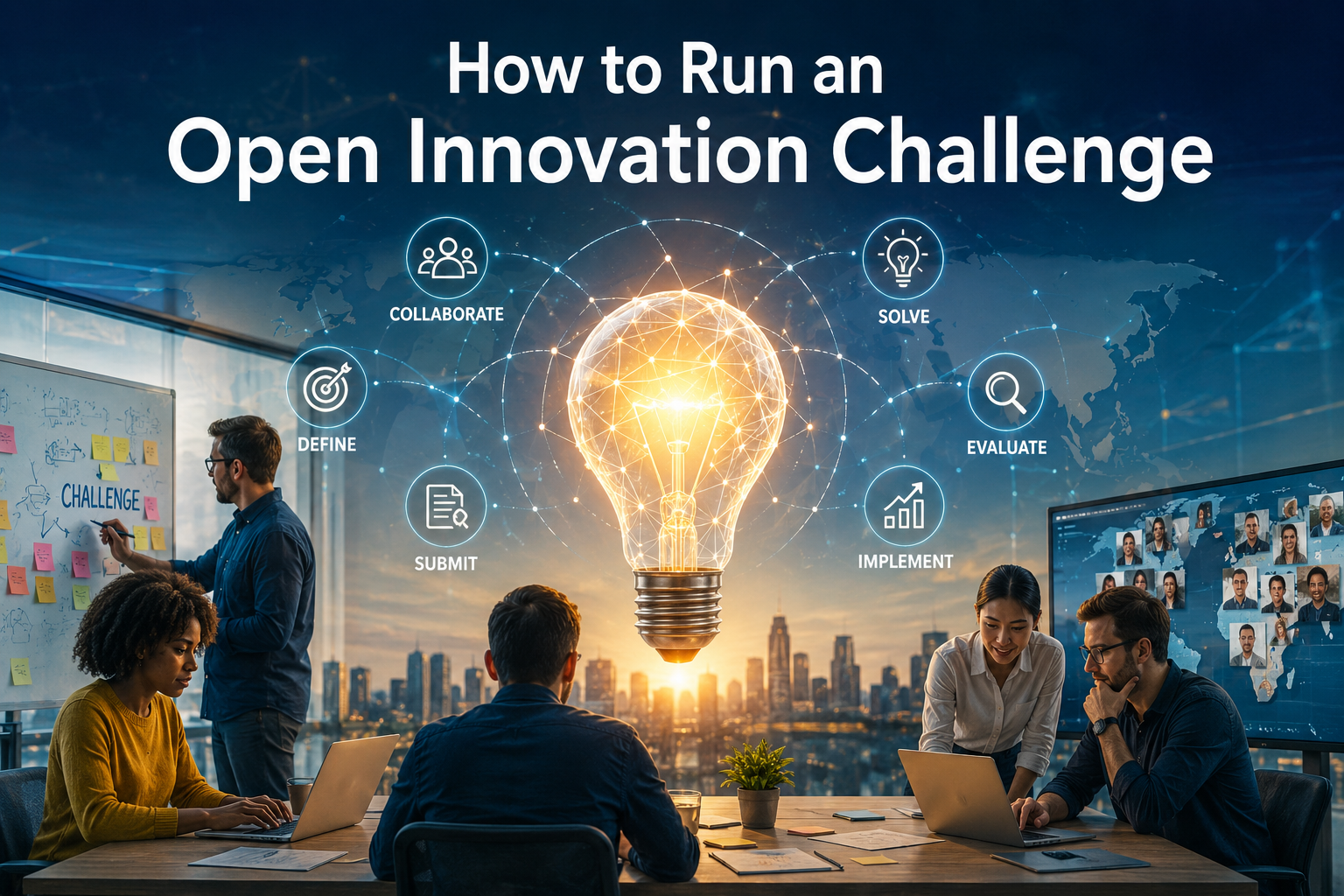
How to Run an Open Innovation Challenge: A Best-Practices Guide for Enterprise Teams
Who this post is for: Innovation leaders, open innovation managers, corporate venture and startup-partnership teams, and R&D leaders who are planning an open innovation challenge — internal, external, or both — and want it to produce real outcomes, not just a pile of submissions and a demo day nobody follows up on.
An open innovation challenge is one of the highest-leverage tools an enterprise has for sourcing solutions it couldn't generate alone. Run well, it brings startups, partners, universities, and internal teams to bear on a strategic problem, surfaces solutions the organization would never have found on its own, and creates a pipeline of vetted opportunities ready to pilot.
Run poorly, it does the opposite. A vague challenge attracts vague submissions. An unstructured evaluation process turns hundreds of applications into weeks of manual review. A great demo day generates excitement and then nothing, because there's no pathway from "winner" to "pilot." The organization concludes open innovation "doesn't work," when in fact the challenge was never set up to succeed.
The difference between the two outcomes isn't luck or budget. It's a set of best practices, applied deliberately, from framing the challenge through to what happens after a winner is chosen — increasingly supported by AI at every stage. This guide lays them out.
What Is an Open Innovation Challenge?
An open innovation challenge is a structured program in which an organization publishes a specific strategic problem or opportunity and invites solutions from participants — internal employees, external startups, partners, universities, or the public — then evaluates the submissions against predefined criteria and advances the strongest into pilots or partnerships.
Two distinctions matter. First, a challenge is problem-first: it starts with a clearly defined need, not an open-ended "send us your ideas." Second, challenges come in two forms that share a workflow but differ in participants and design:
- Internal challenges engage employees to surface ideas, pain points, and solutions from inside the organization — often across business units and geographies that rarely collaborate.
- External (open) challenges invite startups, partners, academics, or the public to submit solutions, expanding the organization's reach far beyond its own walls.
The strongest innovation programs run both, often in parallel — an internal challenge to define and validate a need, an external challenge to source the solution — within a single, governed process.
The 8 Best Practices for Running an Open Innovation Challenge
1. Start with a sharply defined problem, not a broad theme
The single biggest predictor of a challenge's success is the specificity of the problem statement. "We're interested in sustainability solutions" attracts a flood of loosely relevant submissions and an impossible evaluation task. "We need to reduce water consumption in our cooling processes by 30% without capital retrofit" attracts fewer, far more relevant, far more evaluable submissions.
A strong challenge brief names the problem, the constraints, the success criteria, and what a winning solution earns (a pilot, a contract, an investment, a partnership). The narrower and clearer the problem, the higher the quality of what comes back.
2. Decide internal, external, or both — and design each accordingly
Internal and external challenges need different submission experiences. Employees submitting internally need a fast, low-friction form and the confidence that their submission will be seen. External startups need a branded, professional portal, clear IP and confidentiality terms, and a submission process that respects their time. Trying to serve both audiences with a single generic form serves neither.
The best programs decide up front which audiences they're engaging and design the intake, terms, and evaluation criteria for each — while keeping them connected in one system so submissions can be compared and managed together.
3. Define evaluation criteria before the submission window opens
The most common failure in open innovation challenges is inventing the evaluation criteria after the submissions arrive — at which point the criteria get unconsciously shaped to fit the submissions, and the process becomes a committee negotiation rather than a defensible assessment.
Define the scoring criteria, their weights, and who evaluates what before you open submissions. Criteria set in advance produce consistent, comparable scores across every submission and every evaluator. This is what turns a subjective review into a decision you can defend to leadership.
4. Build the submission experience for the participant, not the administrator
A challenge that's easy to administer but hard to submit to will suffer low participation and drop-off from exactly the participants you most want. Custom application forms, shareable links, and branded submission portals lower the friction that causes strong candidates to abandon the process midway.
For external challenges especially, the submission experience is your first impression on a startup deciding whether your organization is worth their time. Make it professional and frictionless.
5. Plan for volume before you have it
A well-promoted external challenge can receive hundreds of submissions in a short window — which is a success that instantly becomes an operational problem if you're not ready. Without structured intake and predefined criteria, the review process becomes manually intensive at exactly the moment when speed matters most for participant experience.
AI-powered support changes this math, and the four capabilities that follow are what let a lean team run a large, rigorous challenge without bottlenecks. Plan the mechanism for handling volume before the volume arrives.
6. Run engagement events that create momentum — and capture it
Demo days, pitch sessions, and virtual engagement events are where an open innovation challenge generates energy and executive visibility. They're also where momentum is most often lost. A great pitch session that isn't connected to a decision-and-pilot pathway produces enthusiasm that evaporates within weeks.
The best practice is to treat the event not as the finish line but as a decision gate: pitches are evaluated against the predefined criteria, decisions are made and documented, and winners move immediately into a defined next step. The energy of a demo day is an asset — but only if you've built the pathway to convert it before the event happens.
7. Build the pathway from winner to pilot before you pick a winner
This is the practice that separates challenges that produce outcomes from challenges that produce press releases. In most organizations, the challenge ends at "winner selected" — and then the winning solution is handed off to a business unit, an email thread, or a spreadsheet, where it stalls.
Before the challenge launches, define what happens to the winner: who owns the pilot, what the pilot is designed to prove, what the success threshold is, and what a successful pilot leads to. When the pathway from challenge to pilot exists inside one governed process — with the submission and evaluation history intact — winners convert into real deployments instead of dissolving into good intentions.
8. Document everything, so the next challenge starts smarter
Every challenge generates intelligence: which framings attracted the best submissions, which criteria predicted success, which participants over- or under-delivered, what happened to the winners. Captured as structured data, that record makes each successive challenge faster to run and better at producing outcomes. Lost in inboxes and one-off decks, it means every challenge starts from scratch. Institutional memory is what turns a one-off event into a repeatable innovation capability.
Where AI Changes How Challenges Run
The best practices above are sound with or without AI. But AI is what makes them achievable at enterprise scale — turning principles that used to require a large team into capabilities that run automatically at every stage of the challenge. Four applications matter most.
AI coaching for the submitter — better submissions before they're submitted. The quality of a challenge's output is capped by the quality of its inputs, and most submitters — especially employees and early-stage startups — don't know how to frame a submission for evaluation. AI coaching closes that gap at the moment of submission: it prompts the participant for missing context, flags a vague value proposition, and guides them toward a complete, evaluable submission before it's ever sent. The result is higher-quality submissions and fewer that get rejected simply because they were poorly framed. It also respects the participant's effort — nobody's strong idea is lost to a weak form.
AI duplication detection — turning overlap into signal. In a high-volume challenge, or across multiple challenges running in parallel, the same solution or a near-identical one arrives more than once, described in different words. Manually, that overlap is invisible until an evaluator happens to notice. AI duplication detection recognizes it across the current challenge, prior challenges, and the broader innovation portfolio automatically — so evaluators aren't reviewing the same thing three times, and, more valuably, so convergence becomes a signal: when multiple independent submissions point at the same solution, that's evidence worth weighting, not redundant work to discard.
AI alignment with strategic objectives — scoring against what the company actually cares about. A submission can be excellent in the abstract and irrelevant to the organization's priorities. AI alignment assessment evaluates each submission against the company's documented strategic objectives — the specific goals the challenge is meant to advance — and surfaces how well it fits before human evaluation begins. This keeps the challenge anchored to strategy rather than novelty, and gives evaluators a consistent, objective starting point instead of relying on each reviewer's personal read of what "strategic fit" means.
AI-assisted review — consistent evaluation at volume. The hardest part of a well-run challenge is applying the same rigor to submission number 300 as to submission number 3. AI-assisted review applies the predefined evaluation criteria consistently across every submission, produces a structured first-pass assessment, and lets human evaluators focus their judgment where it matters most — on the strongest candidates and the genuine edge cases. It doesn't replace the human decision; it removes the manual, inconsistent triage that causes strong submissions to get lost in volume and evaluation quality to drift as fatigue sets in.
Together, these four capabilities change the economics of open innovation. They let a lean team run a large, rigorous, strategically aligned challenge — coaching every submitter, catching every duplicate, scoring every submission against real objectives, and reviewing at volume without sacrificing consistency. This is the difference between an open innovation program that scales and one that collapses under its own success.
Running Multiple Challenges and Campaigns at Scale
For enterprises, open innovation is rarely a single event — it's an ongoing program of multiple challenges and campaigns running in parallel across business units, regions, and strategic priorities. That scale introduces its own requirements:
Portfolio visibility. Innovation leaders need to see all active challenges, pending evaluations, and winners-in-pilot as a single portfolio — not campaign by campaign — to understand how the program is performing and where resources should go.
Consistent structure, flexible execution. Each challenge may target a different audience with different criteria, but they should share a common evaluation structure and data model so submissions and outcomes are comparable across the whole program.
Connection to the full lifecycle. Challenges don't exist in isolation. The strongest programs connect open innovation to internal idea management, technology scouting, and pilot management in one platform — so an external challenge can draw on what scouting already found, and a challenge winner flows directly into governed pilot execution.
This is where a purpose-built open innovation platform replaces the spreadsheets and disconnected tools most programs run on. Traction lets enterprises run multiple internal and external challenges and campaigns in one governed system — with custom branded submission portals, configurable evaluation templates, live virtual demo days, and real-time reporting — and with AI built into every stage: coaching submitters as they submit, detecting duplicates across the portfolio, scoring submissions against strategic objectives, and supporting consistent evaluation at volume. A challenge winner flows directly into pilot management, connected to the broader innovation lifecycle, all inside a SOC 2 Type II certified platform.
👉 See how Traction runs open innovation challenges · Try Traction AI free · Schedule a Demo
Common Mistakes to Avoid
- Launching with a vague problem statement — attracts volume, not quality, and makes evaluation impossible.
- Inventing evaluation criteria after submissions arrive — turns a defensible decision into a committee negotiation.
- Designing one generic experience for both internal and external participants — serves neither well.
- Treating the demo day as the finish line — momentum evaporates without a decision-and-pilot pathway.
- Having no plan for the winner — the most common reason challenges produce excitement but no outcomes.
- Managing it all in spreadsheets and email — breaks exactly where the value is, between selection and execution, and loses the institutional memory that would make the next challenge better.
Frequently Asked Questions
What is an open innovation challenge?
An open innovation challenge is a structured program in which an organization publishes a specific strategic problem and invites solutions from participants — internal employees, external startups, partners, universities, or the public — then evaluates submissions against predefined criteria and advances the strongest into pilots or partnerships. It is problem-first (starting from a clearly defined need) and can be run internally, externally, or both.
How do you run a successful open innovation challenge?
The best practices are: define a sharp, specific problem statement rather than a broad theme; decide whether the challenge is internal, external, or both and design each experience accordingly; set evaluation criteria before the submission window opens; build a low-friction, branded submission experience for participants; plan the mechanism for handling submission volume in advance; run engagement events as decision gates rather than finish lines; build the pathway from winner to pilot before selecting a winner; and document everything so the next challenge starts smarter. The single most important factors are the specificity of the problem and the existence of a defined pathway from winner to real outcome.
What is the difference between an internal and external innovation challenge?
An internal challenge engages employees to surface ideas, pain points, and solutions from inside the organization, often across business units that rarely collaborate. An external (open) challenge invites startups, partners, academics, or the public to submit solutions, expanding reach beyond the organization. They share a workflow but differ in participants, submission experience, IP and confidentiality terms, and evaluation criteria. Many strong programs run both in parallel — an internal challenge to define and validate a need, an external challenge to source the solution.
How does AI improve an open innovation challenge?
AI operates at four points in the challenge lifecycle. At submission, AI coaching prompts participants for missing context and guides them toward complete, evaluable submissions — raising input quality before anything is reviewed. During intake, AI duplication detection recognizes overlapping submissions across the current and prior challenges automatically, turning convergence into signal rather than redundant review. Before human evaluation, AI assesses each submission's alignment with the organization's documented strategic objectives, keeping the challenge anchored to priorities. And during review, AI applies the predefined criteria consistently across every submission, letting a lean team evaluate at volume without the rigor drifting from the first submission to the last.
Can AI help evaluate innovation challenge submissions fairly?
Yes, when it's applied to enforce consistency rather than replace human judgment. AI-assisted review applies the same predefined evaluation criteria to every submission in the same way, which counters the inconsistency and fatigue that cause manual evaluation to drift across hundreds of submissions. Combined with AI alignment scoring — which assesses each submission against the company's stated strategic objectives before human review — this gives every submission a consistent, objective starting point. Human evaluators then focus their judgment on the strongest candidates and genuine edge cases, making the final decision, with AI having removed the inconsistent manual triage beneath it.
How do you evaluate submissions in an open innovation challenge?
Define scoring criteria and their weights before the submission window opens, and apply them consistently across every submission and every evaluator. Evaluating by criterion rather than by overall impression, and scoring every submission the same way, produces comparable, defensible results. For high-volume challenges, structured intake, AI-assisted duplicate detection, and AI review let a small team assess a large number of submissions without sacrificing rigor. The goal is a decision you can defend to leadership, supported by documented rationale rather than committee negotiation.
How do you handle a large volume of submissions?
Plan for volume before it arrives. Use structured intake forms so every submission includes the context needed for evaluation, predefined criteria so scoring is consistent, AI duplication detection to surface overlapping submissions automatically, and AI-assisted review to apply the criteria consistently at scale. A well-promoted external challenge can receive hundreds of submissions in a short window; without these mechanisms, review becomes manually intensive at exactly the moment when speed matters most for participant experience. A purpose-built platform lets a lean team manage high volume without bottlenecks.
What happens after an open innovation challenge ends?
The winning solutions should move immediately into a defined next step — most often a structured pilot with a named owner, a success threshold, and a documented objective. The most common failure in open innovation is having no plan for the winner, so the selected solution stalls in an email thread or spreadsheet. The best practice is to build the pathway from challenge winner to pilot before the challenge launches, ideally within one system so the submission and evaluation history stays intact, and to document the outcomes so the next challenge benefits from the learning.
Can you run open innovation challenges and internal idea campaigns in one platform?
Yes. A purpose-built open innovation platform lets enterprises run multiple internal and external challenges and campaigns in parallel within one governed system — with distinct submission experiences for each audience, a shared evaluation structure, AI support at every stage, portfolio visibility across all active programs, and a connection to internal idea management, technology scouting, and pilot management. Running them in one platform (rather than disconnected tools) is what makes the program comparable across challenges and connected to the full innovation lifecycle.
Related Reading
- How to Run an Open Innovation Challenge Without a Big Team or Budget
- Stop Asking Employees for Big Ideas. Ask Where It Hurts.
- Why Innovation Programs Lose Participation Over Time
- How to Decide Which Innovation Projects to Fund, Stop, or Scale
- Why Pilot Management Software Is the Missing Link in Innovation Execution
- What Is an Innovation Pipeline? A Practical Guide for Enterprise Teams
About the Author
Neal Silverman is the co-founder and CEO of Traction Technology. He spent 15 years as a senior executive at IDG — running multiple business units connecting enterprises with emerging technologies through conferences, councils, data services, and professional consulting practices. That firsthand experience watching how enterprises discover, evaluate, and lose track of emerging technology relationships is the origin story of Traction. He works with innovation teams at Armstrong, Bechtel, Ford, GSK, Kyndryl, Merck, and Suntory. Connect on LinkedIn
About Traction Technology
Traction Technology is an AI-powered innovation management software platform trusted by Fortune 500 innovation teams including Armstrong, Bechtel, Ford, GSK, Kyndryl, Merck, and Suntory. Built on Claude (Anthropic) and AWS Bedrock with a RAG architecture, Traction manages the full innovation lifecycle — from technology scouting and open innovation through idea management, RFI management, and pilot management — with AI-generated Trend Reports, AI Company Snapshots, duplication detection, and decision coaching built in.
Traction AI scouts across a database of over 1 million verified companies — retrieving real, current results rather than generating hallucinated names. One annual subscription at $4,000 gives you the full capabilities of an enterprise innovation team — every module, every AI capability, and unlimited View-Only access for every stakeholder at no additional cost. No setup fee. No data migration charges. Featured in the Gartner Market Guide for AI-Enabled Innovation Management Platforms, February 2026. SOC 2 Type II certified.
Try Traction AI Free · View Pricing · Schedule a Demo · tractiontechnology.com





.webp)