
5 Best AI Governance & Model Security Companies to Evaluate in 2026 (Scored): The Traction Five
A note on this list: This shortlist was generated using Traction AI — our platform for technology scouting across a database of over 1 million verified companies. The query: "AI companies enabling enterprise AI governance, risk management, and model security in 2026 — across governance and compliance platforms, model risk and monitoring, AI observability, LLM and agent security, and responsible-AI tooling."
Each profile includes the full Traction AI Company Snapshot — the same output Traction generates for enterprise innovation teams conducting live technology scouting evaluations. These Traction Scores and Company Snapshots were generated by Traction AI against a database of over 1 million verified companies. They are original, first-party assessments that exist nowhere else — not a list compiled from public sources.
Who this post is for: CIOs, Chief AI Officers, Chief Risk and Compliance Officers, and Heads of AI Governance who have to answer a question that got sharper on August 2, 2026: can we prove our AI systems are governed, compliant, and defensible to a regulator?
Why AI Governance Became a 2026 Procurement Gate, Not a 2027 Project
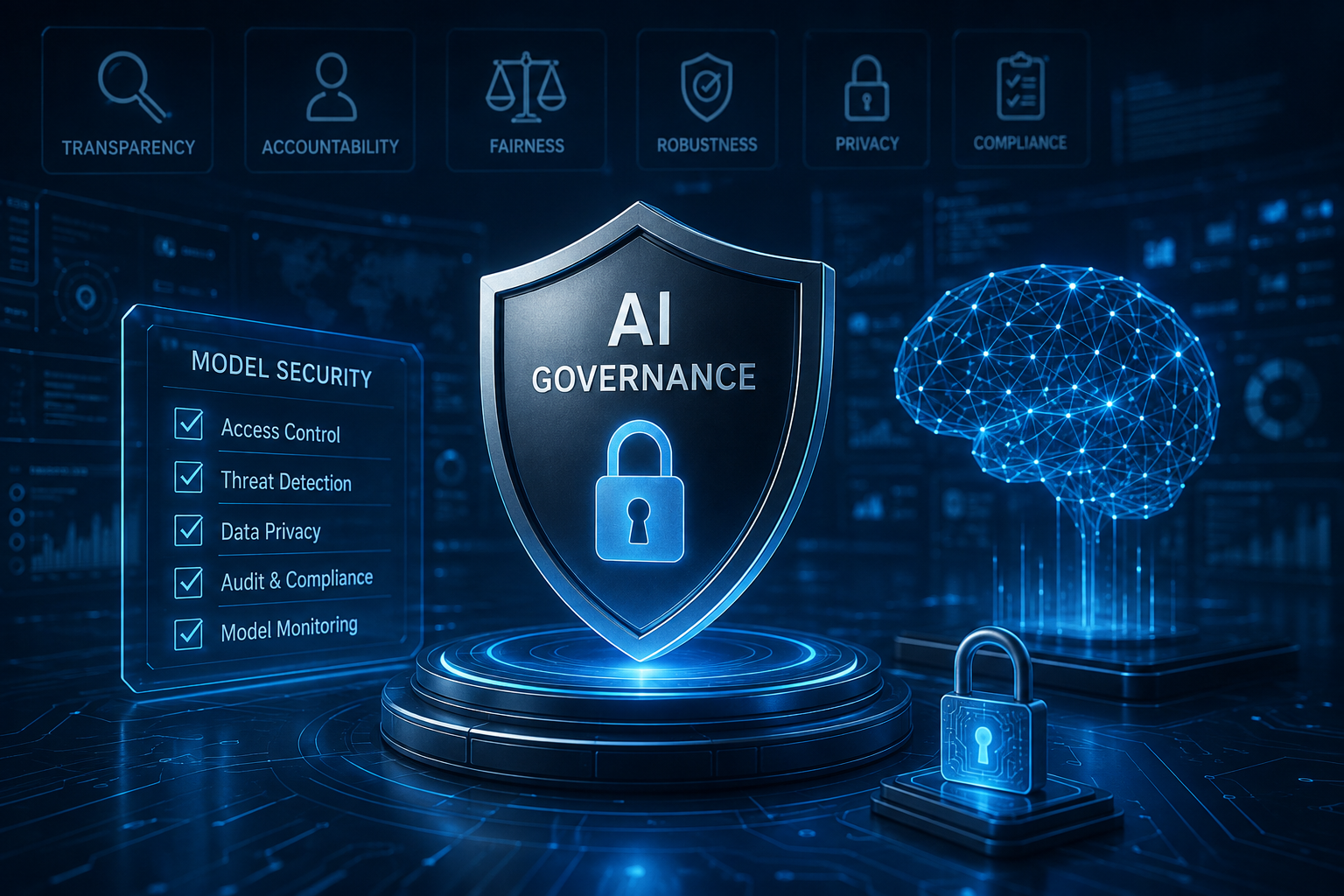
For two years, "AI governance" was a slide in a strategy deck — a principle everyone endorsed and few operationalized. In 2026 it became a requirement with a deadline and a penalty attached.
The EU AI Act's high-risk provisions took effect August 2, 2026, catalyzing global adoption of formal AI governance and driving organizations to implement ISO 42001 certification and similar standards well beyond Europe. Non-compliance carries penalties reaching €35 million or 7% of global turnover. At the same time, high-profile incidents — biased models, privacy breaches, and autonomous systems taking actions nobody authorized — have pushed AI risk from a technical footnote to a board-level concern.
The result is a shift most enterprises have not fully absorbed: governance is no longer something you add after deploying AI. It is becoming the gate you pass through to deploy AI at all — and, increasingly, a criterion in how your own AI vendors are evaluated. Organizations are moving from ad-hoc AI risk management toward systematic governance frameworks that embed controls throughout the AI lifecycle, from development through deployment and monitoring.
And the ground keeps shifting. Agentic AI has opened a governance gap the last generation of tools never anticipated: autonomous agents that plan across multiple steps, use tools, call external APIs, and make decisions traditional model governance doesn't cover. Governing a static model is one problem. Governing an agent that acts on its own is another — and both now sit on the enterprise's plate simultaneously.
The five companies below were surfaced by Traction AI from a database of over 1 million verified companies and scored across scalability, security and compliance, market validation, financial stability, product maturity, and operational execution risk. Together they span the governance stack — from end-to-end governance platforms to model monitoring, audit defensibility, shadow-AI control, and adoption governance.
Company 1: Credo AI
Why they made the shortlist: Credo AI is the category-defining leader in AI governance — a unified platform for discovering, assessing, governing, monitoring, and reporting on every AI agent, model, and application across the enterprise, with a governance library mapping 166+ regulations and 116+ controls to frameworks like the EU AI Act, NIST AI RMF, and ISO 42001. Named a Leader in the Forrester Wave for AI Governance, with customers including Mastercard, PepsiCo, and Cisco and $41.3M raised, Credo AI earns the highest Traction Score on this list at 82/100.
Traction AI Company Snapshot
Best-fit deployment context: Large enterprises and government agencies in regulated industries — financial services, healthcare, government — building comprehensive AI governance across generative and agentic AI, particularly those needing to demonstrate EU AI Act, NIST AI RMF, or ISO 42001 compliance. Strongest fit where AI is deployed at scale across many models and agents and centralized oversight is a board-level requirement.
The question to ask first: For our specific regulatory obligations and our mix of generative and agentic AI, how quickly can the platform map our existing AI systems to the required controls — and what does the runtime enforcement look like for our autonomous agents specifically?
Company 2: Arthur
Why they made the shortlist: Arthur monitors, secures, and governs AI in production — from ML model monitoring and drift detection through runtime security for agentic AI, including shadow-agent discovery, prompt-injection defense, and behavioral guardrails. With SOC 2 Type II certification, federal government (DoD) contracts, $60.3M raised, and a first-mover position in agent discovery and governance, Arthur is the observability and model-security anchor of this list. Traction Score: 72/100.
Traction AI Company Snapshot
Best-fit deployment context: Enterprises in financial services, insurance, healthcare, and federal government deploying production AI/ML systems who need model monitoring and drift detection today and agentic-AI governance and runtime security as they deploy agents. Particularly strong for organizations that want observability and governance integrated with an existing SOC security stack (CrowdStrike, Splunk, Datadog).
The question to ask first: For our production model and agent footprint, what sensor deployment does full visibility require, what performance overhead does the instrumentation add, and how does the agentic runtime security integrate with our existing SOC tooling?
Company 3: Castlepoint Systems
Why they made the shortlist: Castlepoint delivers AI governance where auditability and defensibility matter most — using Explainable AI to auto-classify and manage records across every system, apply lifecycle controls, and produce transparent, auditable decisions for compliance and legal requirements. With a manage-in-place model, deep government and defense validation (UK Ministry of Defence, two-thirds of Australian federal portfolios), and its Generative AI Governance module, Castlepoint is the audit-and-defensibility anchor of this list. Traction Score: 68/100.
Traction AI Company Snapshot
Best-fit deployment context: Government agencies, defense organizations, and highly regulated enterprises — particularly in financial services, legal, and critical infrastructure — that need defensible, auditable AI governance across records, privacy, and GenAI use, with data that must remain in place. Strongest fit where audit-readiness and explainability for regulators are the primary requirements, especially in Asia-Pacific and Five Eyes countries.
The question to ask first: For our regulatory and audit obligations, how does the Explainable AI produce a defensible decision trail that would satisfy an auditor — and what does the manage-in-place deployment require across our existing systems without data migration?
Company 4: CultureAI
Why they made the shortlist: CultureAI governs the AI risk most enterprises can't even see — employee use of AI tools, including shadow AI. Its AI Usage Control platform detects unsafe AI use across sanctioned and unsanctioned tools like ChatGPT, Gemini, and Copilot, enforces role-aware policies, and delivers real-time behavioral coaching, with compliance mapping to GDPR, HIPAA, ISO 42001, the EU AI Act, and NIST AI RMF. It is the shadow-AI and human-risk anchor of this list. Traction Score: 62/100.
Traction AI Company Snapshot
Best-fit deployment context: Mid-market to enterprise organizations in regulated industries — financial services, healthcare, legal — seeking to govern employee AI usage, control shadow AI, and prevent sensitive data leakage into AI tools while enabling safe adoption. Strongest fit where the governance priority is the human/usage layer rather than the model layer, and where fast, lightweight, browser-based deployment is valued.
The question to ask first: For our environment, what proportion of employee AI usage does the browser-based approach actually capture — including desktop apps, mobile, and API-based tools — and how does the real-time coaching enforce our specific data-handling policies at the moment of risk?
Company 5: Portal26
Why they made the shortlist: Portal26 governs the full arc of enterprise AI adoption — from shadow-AI discovery through agentic AI management, prompt protection, audit and forensics, and ROI value realization — with a three-stage "visibility to value" framework and NIST FIPS 140-2 certified components. Founded in 2019 with $15M raised and recognition from Gartner and TAG Cyber, Portal26 is the adoption-governance and value-realization entry on this list. It is included as the emerging "one to watch." The Traction Score of 52/100 reflects early stage and limited disclosed traction — not a weak product.
Traction AI Company Snapshot
Best-fit deployment context: Enterprises in regulated industries — financial services, healthcare, government, technology — seeking to govern generative and agentic AI adoption end to end, from shadow-AI discovery through security to demonstrated ROI, particularly those that value encryption-in-use for secure AI-powered search. Best approached as a structured pilot given the early-stage traction profile.
The question to ask first: Can you provide two enterprise customer references at our scale, and for our environment, how does the three-stage framework move from shadow-AI visibility to a measured ROI outcome — and what does the agentic AI token control and prompt protection cover specifically?
How Enterprise Teams Should Use This List
A shortlist is the beginning of an evaluation, not the end. The Traction Scores above reflect AI-generated assessments from verified company data — a starting point for structured evaluation, not a substitute for it.
This board skews amber, and that is an accurate signal about the category, not a knock on the companies. AI governance is, in the words of the market itself, an emerging category with limited enterprise budget allocation and competing priorities. Even the category leader carries market-education risk; most of these companies are Series A or early growth. An honest board here is an amber one — and the opportunity for early-moving enterprises is precisely that the category is still forming.
The five companies map to five distinct governance needs, and the right starting point depends on which gap binds hardest for you:
End-to-end governance and compliance — Credo AI is the platform for centralized oversight across all your models and agents, mapped to the regulations you answer to. Start here if you need a governance system of record.
Model monitoring and agentic security in production — Arthur watches what your models and agents actually do in production, integrated with your SOC stack. Start here if the gap is production observability and runtime risk.
Audit defensibility and records — Castlepoint produces the explainable, auditable decision trail regulators ask for, with data managed in place. Start here if the priority is proving governance to an auditor.
Shadow AI and employee usage — CultureAI governs how your people actually use AI tools, sanctioned and not. Start here if the gap is the human/usage layer and data leakage into AI tools.
AI adoption governance and ROI — Portal26 governs the arc from adoption to value realization. Consider it as a pilot where the framing fits.
For each company relevant to your mandate:
Step 1 — Identify which governance layer you're actually missing. Governance platform, production monitoring, audit defensibility, shadow-AI control, or adoption ROI — the map above tells you which company addresses which. Don't buy a monitoring tool for a compliance-mapping gap.
Step 2 — Send a structured RFI. Start with the question to ask first in each profile. Add the compliance frameworks you must satisfy (EU AI Act, NIST AI RMF, ISO 42001), the certifications your evaluation requires (SOC 2 Type II, and note where a company holds only Type I), integration specs for your AI stack and SOC tooling, and reference customers at comparable scale.
Step 3 — Pilot against a documented governance gap. Define the specific governance outcome the pilot must produce — a mapped control set, a working runtime enforcement policy, an audit-ready decision trail — and measure against it before selecting the vendor.
Step 4 — Remember the evaluation record is itself a governance artifact. In a regulated AI environment, the documented rationale for why you selected your governance tooling is part of your compliance posture. Capture it.
Traction AI generates shortlists and Company Snapshots like the ones above on demand — for any technology category, against a verified database of over one million companies.
👉 Run your own AI governance scouting query — try Traction AI free · View Pricing · Schedule a Demo
Frequently Asked Questions
How were these five companies selected?
This shortlist was generated using Traction AI — our platform for technology scouting across a database of over one million verified companies. The query targeted AI companies enabling enterprise AI governance, risk management, and model security in 2026 across governance and compliance platforms, model risk and monitoring, AI observability, LLM and agent security, and responsible-AI tooling. Companies were evaluated using the Traction scoring framework across scalability, security and compliance, market validation, financial stability, product maturity, and operational execution risk.
What is a Traction Score?
The Traction Score is an AI-generated evaluation score produced by Traction AI for every company in an active evaluation. It assesses a company across six weighted dimensions — scalability, security and compliance, market validation, financial stability, product and technology maturity, and operational and execution risk — and produces a score out of 100 with a breakdown of contributing factors. It is designed to give enterprise innovation teams a structured, comparable starting point for vendor evaluation — not a definitive recommendation.
Why did AI governance become urgent in 2026?
The EU AI Act's high-risk provisions took effect on August 2, 2026, with penalties reaching €35 million or 7% of global turnover, catalyzing global adoption of formal AI governance frameworks and driving organizations to implement standards like ISO 42001 and the NIST AI RMF well beyond Europe. At the same time, high-profile incidents involving biased models, privacy breaches, and autonomous AI systems have elevated AI risk to a board-level concern. The result is that governance has shifted from an optional principle to a requirement for deploying AI — and increasingly a criterion in how enterprises evaluate their own AI vendors.
What is the difference between AI governance and AI security?
AI security focuses on defending AI systems from threats — prompt injection, model theft, adversarial attacks. AI governance is broader: it is the discipline of ensuring AI systems are compliant, auditable, risk-managed, and aligned with regulations and organizational policy across their lifecycle. The two overlap — several companies on this list do both — but the governance question is "can we prove this AI system is compliant and defensible?" while the security question is "can this AI system be attacked?" Enterprises in 2026 increasingly need both, and agentic AI raises the stakes on each.
How is governing agentic AI different from governing traditional models?
Traditional model governance addresses static systems: a model produces outputs, and you monitor them for accuracy, drift, and bias. Agentic AI governance must address systems that plan across multiple steps, use tools, call external APIs, and take autonomous actions — which introduces new risk surfaces (unauthorized actions, unsafe tool sequences, decision chains) that static model governance does not cover. Several companies on this list — notably Credo AI's Agent Governor and Arthur's agent discovery — have built purpose-built capabilities for runtime governance and enforcement of autonomous agents, a nascent but rapidly growing requirement.
Can Traction AI generate a similar shortlist for other governance categories?
Yes — Traction AI generates on-demand shortlists and Company Snapshots for any technology category against a verified database of over one million companies. Adjacent categories worth exploring include AI security and threat defense, data governance and lineage, model risk management, responsible-AI and bias testing, and GRC platforms. Each query returns verified company profiles with AI Snapshots and Traction Scores. Try it free at tractiontechnology.com/demo-traction-ai.
Related Reading — The Traction Five Series
- Manufacturing AI Startups Worth Evaluating in 2026: The Traction Five
- Healthcare AI Startups Worth Evaluating in 2026: The Traction Five
- Financial Services AI Startups Worth Evaluating in 2026: The Traction Five
- Cybersecurity AI Startups Worth Evaluating in 2026: The Traction Five
- Logistics & Supply Chain AI Startups Worth Evaluating in 2026: The Traction Five
Each post in the Traction Five series features five real AI companies — scouted, scored, and profiled by Traction AI from a database of over 1 million verified companies. New editions cover a different sector each month.
About Traction Technology
Traction Technology is an AI-powered innovation management software platform trusted by Fortune 500 innovation teams including Armstrong, Bechtel, Ford, GSK, Kyndryl, Merck, and Suntory. Built on Claude (Anthropic) and AWS Bedrock with a RAG architecture, Traction manages the full innovation lifecycle — from technology scouting and open innovation through idea management, RFI management, and pilot management — with AI-generated Trend Reports, AI Company Snapshots, duplication detection, and decision coaching built in.
Traction AI scouts across a database of over 1 million verified companies — retrieving real, current results rather than generating hallucinated names. One annual subscription at $4,000 gives you the full capabilities of an enterprise innovation team — every module, every AI capability, and unlimited View-Only access for every stakeholder at no additional cost. No setup fee. No data migration charges. Featured in the Gartner Market Guide for AI-Enabled Innovation Management Platforms, February 2026. SOC 2 Type II certified.
Try Traction AI Free · View Pricing · Schedule a Demo · tractiontechnology.com






.webp)