The Traction Five: AI Companies Transforming Manufacturing in 2026
A note on this list: This shortlist was generated using Traction AI — our platform for technology scouting across a database of over 1 million verified companies. The query: "AI companies transforming advanced manufacturing in 2026 — across robotics, computer vision, workforce intelligence, data infrastructure, and digital manufacturing."
Each profile includes the full Traction AI Company Snapshot — the same output Traction generates for enterprise innovation teams conducting live technology scouting evaluations. Every Traction Score, every strength, every challenge, and every risk factor is AI-generated from verified company data — not editorial opinion.
Who this post is for: Innovation managers, Heads of Technology Scouting, VPs of Engineering, and R&D leaders at manufacturing organizations who want a verified, scored shortlist of AI companies worth evaluating — not a generic list of names.
Why Manufacturing AI Is the Most Active Evaluation Category in 2026
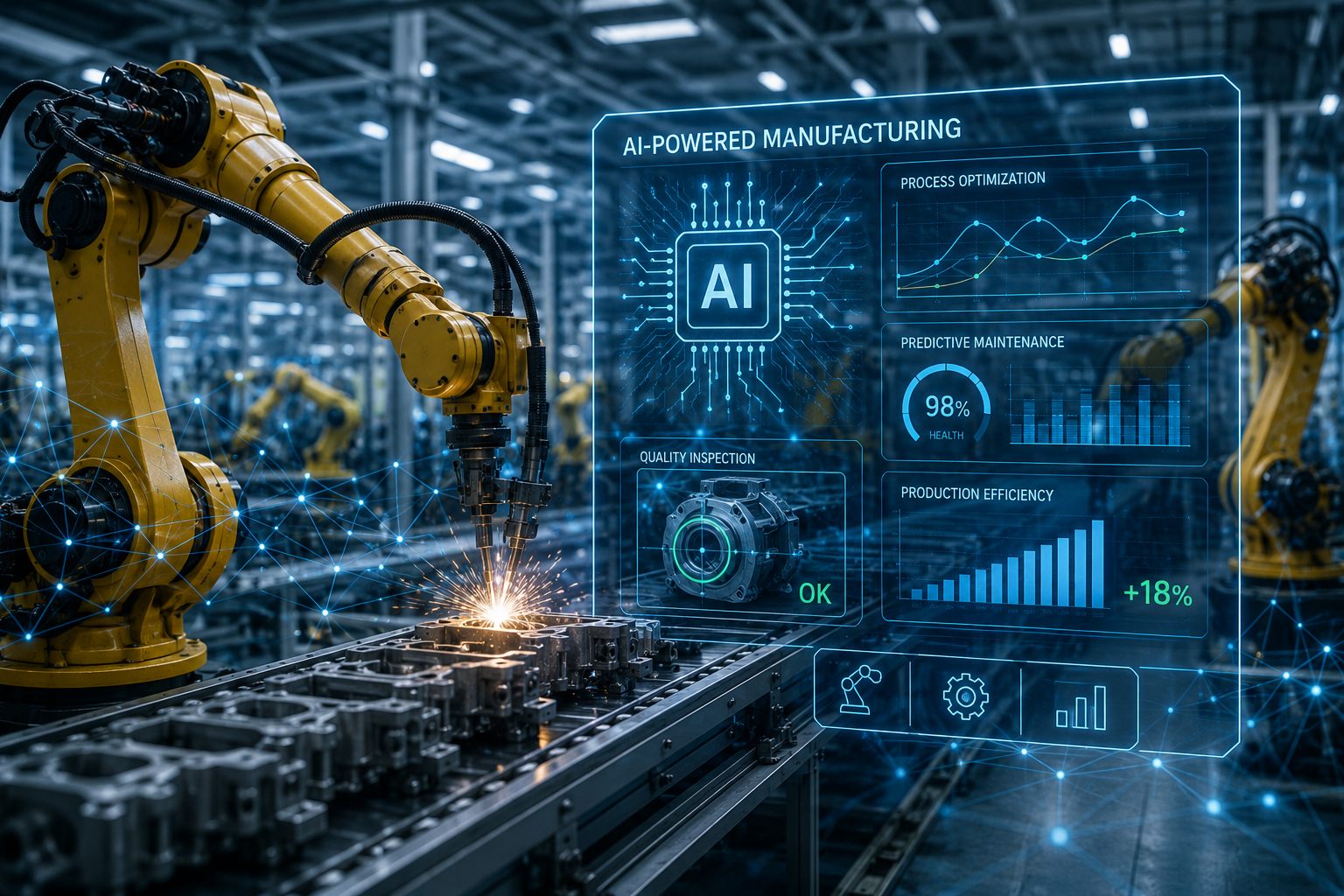
The AI in manufacturing market is projected to surge from $17.44 billion in 2025 to $115.76 billion by 2030 — a compound annual growth rate of 46.02%. Enterprise innovation teams are managing more simultaneous technology mandates than at any point in manufacturing history — advanced robotics, computer vision quality inspection, AI-powered workforce development, digital manufacturing platforms, and AI data infrastructure all competing for evaluation bandwidth simultaneously.
The challenge is not finding companies. It is finding the right ones — production-ready, financially stable, and relevant to the specific operational mandate being addressed.
Market Signal: Manufacturing AI
Traction AI Trend Report
A snapshot of what Traction AI's Trend Report surfaces for this market — the same category-level intelligence enterprise teams use to frame an evaluation before shortlisting vendors.
Trends Now
- Autonomous mobile robots (AMRs) navigating complex facilities without fixed infrastructure
- Edge AI processing enabling real-time quality inspection and control in under 10 milliseconds
- Generative AI optimizing production schedules, predictive maintenance, and work instructions
- AI-enhanced digital twins simulating entire production lines before physical changes
Where It's Heading
- Manufacturing AI reaching mid-market via cloud platforms and subscription pricing (300–400% expansion)
- Lights-out factory evolution — minimal human intervention on night and weekend shifts
- Manufacturing-as-a-Service platforms sharing AI-enabled capacity across customers
- Cross-facility learning networks sharing best practices and predicting issues collectively
Risks to Weigh
- Cyberattacks on AI-connected systems risking physical damage, downtime, and IP theft
- Cyclical capital spending — recessions delaying or cancelling AI transformation projects
- Algorithmic reliability in safety-critical applications where failures cause injury or recalls
Want this for your market? Generate instant Trend Reports or a Market SWOT Analysis on any market or business challenge you want to analyze.
Try Traction AI Free
The five companies below were surfaced by Traction AI from a database of over 1 million verified companies and scored using the Traction evaluation framework across scalability, security and compliance, market validation, financial stability, product maturity, and operational execution risk.
Company 1: Machina Labs
Why they made the shortlist: Machina Labs provides AI-driven robotic metal forming that eliminates traditional dies and molds — enabling rapid production of complex metal parts in days instead of months. With $172M raised, CMMC Level 2 and ITAR certification, and blue-chip customers including Lockheed Martin, NASA, and the U.S. Air Force, Machina Labs represents one of the most compelling convergences of AI and advanced manufacturing currently available for enterprise evaluation.
Description
Machina Labs provides AI-driven robotic incremental sheet metal forming that eliminates the need for dies and molds — enabling rapid production of complex metal parts in days instead of months. The RoboCraftsman platform serves critical aerospace, defense, automotive, and hypersonics markets with sub-millimeter precision and aerospace-grade tolerances.
Key Takeaways
- AI-driven robotic metal forming eliminates dies and molds — producing complex metal parts in days instead of 56 weeks for traditional tooling-based methods
- Serves aerospace, defense, automotive, and hypersonics markets with sub-millimeter precision
- Blue-chip customers including Lockheed Martin, NASA, U.S. Air Force, and Toyota
- $172.3M raised across Series A, B, and C with strategic investors including Lockheed Martin Ventures and Woven Capital
- ITAR registered and CMMC Level 2 certified — positioned for aerospace, defense, and government sectors
- Eliminates tooling costs — savings of $1M+ per design by removing dies and molds
Strengths and Differentiators
- Proprietary AI-guided robotic incremental sheet metal forming — difficult for competitors to replicate
- Closed-loop process control with real-time scanning and sub-millimeter correction
- CMMC Level 2 certification and ITAR registration for defense and classified programs
- Multi-material capability — Inconel, Niobium C103, titanium, steel, aluminum, refractory metals
- Elastic factory model scales capacity on-demand without capital-intensive tooling investments
- End-to-end manufacturing cell integrating forming, scanning, trimming, drilling, finishing, and heat treatment
Challenges
- Capital-intensive business model requires continuous funding
- Part size limited by robotic cell dimensions — not suitable for ultra-high-volume commodity production
- Long sales cycles for aerospace and defense customers
- Requires skilled workforce combining robotics, AI, and materials science expertise
Traction Score 72/100 — Machina Labs demonstrates strong enterprise readiness with validated technology deployed at blue-chip aerospace and defense customers. Critical compliance certifications — CMMC Level 2, ITAR — and $172M in strategic funding provide confidence. Product maturity is high with multiple commercial deployments. However, scaling challenges and limited broader market validation beyond defense and aerospace temper the score. Suitable for enterprise pilots and partnerships particularly in defense, aerospace, and specialized automotive applications.
Generated by Traction AI · June 2026
Company 2: Invisible AI
Why they made the shortlist: Invisible AI provides a no-code, edge-based computer vision platform that tracks human motion and objects on factory floors in real time — improving quality, productivity, and safety without facial recognition or biometric data collection. With Toyota, Mercedes-Benz, Ford, BMW, General Motors, and Nissan as enterprise customers, ISO 27001 certification, and $21.6M raised, Invisible AI is one of the most enterprise-validated computer vision platforms currently available for manufacturing evaluation.
Description
Invisible AI is a next-generation computer vision company offering a no-code, edge-based visual intelligence platform to improve quality, productivity, and safety in manufacturing industries. Its low-bandwidth cameras deploy at each workstation to track real-time human motion — helping customers run accurate, reliable, and safe operations without facial recognition or biometric data collection.
Key Takeaways
- Edge-based AI Vision Execution System tracking human motion and objects in real time — no facial recognition, no biometric data collection
- Enterprise customers including Toyota, Mercedes-Benz, Ford, BMW, General Motors, and Nissan
- Patented technology with ISO 27001 certification and NVIDIA-powered edge computing requiring no additional bandwidth
- $21.6M raised — $15M Series A — with credible investors including 8VC, K9 Ventures, and Sierra Ventures
- Privacy-first design with automatic face blurring — critical for workforce acceptance and regulatory compliance
- Founded November 2018 — rapid market penetration in complex automotive environments within four to five years
Strengths and Differentiators
- Privacy-first design with no facial recognition and automatic face blurring
- Edge-based architecture eliminating bandwidth requirements and enabling on-premise data storage
- Built-in NVIDIA AI chipset with 3D depth-sensing cameras — real-time tracking of 17 human body joints
- Proven deployment across Toyota, Mercedes-Benz, Ford, BMW, GM, and Nissan facilities
- No-code platform enabling rapid deployment without extensive IT resources
- Comprehensive PLC/MES integrations for seamless connection to existing manufacturing execution systems
Challenges
- Manufacturing workforce resistance to camera monitoring despite privacy protections
- Computer vision accuracy dependent on lighting conditions and camera placement
- GDPR, CCPA, and union negotiations around workplace monitoring create regulatory complexity
- Long enterprise sales cycles — 12 to 18 months in automotive and aerospace
- Hardware dependency creating supply chain and pricing vulnerability — NVIDIA chipset dependency
- Customer concentration risk — heavy focus on automotive sector
Traction Score 72/100 — Invisible AI demonstrates strong enterprise readiness with proven deployments across tier-1 automotive manufacturers including Toyota North America-wide deployment, Mercedes-Benz, Ford, BMW, GM, and Nissan. Mature product capabilities and ISO 27001 certification support enterprise adoption. However, moderate funding ($21.6M total), concentration in automotive, and hardware dependency create some scaling risk. The score reflects a mature, enterprise-ready solution with validated market traction but financial and scaling limitations compared to larger competitors.
Generated by Traction AI · June 2026
Company 3: CloudFactory
Why they made the shortlist: CloudFactory provides full-lifecycle AI support — from data preparation through inference evaluation — combining technology with a distributed human workforce to help enterprises train and sustain AI at scale. With $78M raised, 15 years of operational history, and enterprise customers including Microsoft, Mitsubishi Electric, and Matterport, CloudFactory addresses one of the most critical and underserved infrastructure challenges in manufacturing AI deployment: high-quality training data and inference validation at scale.
Description
CloudFactory helps tech teams train and sustain AI with high-quality data at scale. As a social enterprise, CloudFactory connects one million talented people to online work while providing full-lifecycle AI support — from data preparation through inference evaluation — combining proprietary technology with a distributed human workforce for human-in-the-loop AI oversight.
Key Takeaways
- Established AI data services provider founded in 2010 — 15 years of operational history with proven enterprise customer base
- Full-lifecycle AI platform covering data preparation, model training, AI deployment, and inference evaluation
- High-stakes industries including healthcare, finance, autonomous vehicles, and manufacturing with human-in-the-loop AI oversight
- $78M raised including significant PE investment from FTV Capital in 2019
- Enterprise customers include Microsoft, Mitsubishi Electric, Matterport, and Expensify
- Recommended for enterprises requiring high-quality AI training data and inference validation in regulated or safety-critical applications
Strengths and Differentiators
- 15 years of operational experience in AI data services with proven enterprise customer base
- Full-lifecycle AI platform — data preparation through inference evaluation — in one provider
- Human-in-the-loop approach combining technology with expert oversight for high-stakes applications
- Deep vertical expertise across 14 industries including healthcare, finance, and autonomous vehicles
- Strong financial backing with $78M raised including private equity investment
- Focus on trustworthy AI and inference evaluation addresses emerging enterprise need for AI governance
Challenges
- Competition from automated data labeling platforms and in-house AI teams
- Dependence on distributed human workforce creates scalability constraints and quality variability
- Labor-intensive business model limits margin scalability
- GDPR and HIPAA compliance challenges across distributed global workforce
- Private equity backing suggests pressure for growth and potential exit strategy within typical PE timeline
Traction Score 72/100 — CloudFactory demonstrates solid enterprise readiness with strong market validation, proven financial stability, and mature service delivery. The 15-year history, enterprise customer base including Microsoft and Mitsubishi Electric, and $78M in funding provide confidence. However, the labor-intensive business model, limited proprietary technology differentiation, and distributed workforce security considerations create moderate concerns for large-scale enterprise adoption. Well-suited for specific high-stakes AI use cases requiring human oversight.
Generated by Traction AI · June 2026
Company 4: 8chili
Why they made the shortlist: 8chili provides a Digital Twin Workforce OS combining VR, AR, and AI-powered microlearning for pharmaceutical and advanced manufacturing — addressing the skilled workforce development challenge that is constraining AI adoption across manufacturing globally. With SOC 2 Type 2, ISO 27001, and 21 CFR Part 11 certifications, and enterprise customers including Cipla, Lupin, and Fresenius Kabi, 8chili is the most compliance-ready workforce development platform currently available for regulated manufacturing environments.
Description
8chili provides a Digital Twin Workforce OS combining VR, AR, and AI-powered microlearning for pharmaceutical and advanced manufacturing. The platform addresses the skilled workforce development challenge constraining AI adoption globally — with SOC 2 Type 2, ISO 27001, and 21 CFR Part 11 certifications making it the most compliance-ready workforce development platform for regulated manufacturing environments.
Key Takeaways
- Purpose-built for heavily regulated GxP environments with end-to-end audit trail documentation
- Integrated tri-platform approach — VR, AR, AI microlearning — provides comprehensive training ecosystem
- 200+ pre-built SOPs across OSD, Parenteral, API, and Labs accelerate deployment
- Enterprise customers including Cipla, Lupin, Fresenius Kabi, and Strides demonstrate pharmaceutical credibility
- SOC 2 Type 2, ISO 27001, and 21 CFR Part 11 certifications — strong compliance posture for regulated environments
- Multi-language support for diverse global pharmaceutical manufacturing workforce needs
Strengths and Differentiators
- Purpose-built for GxP compliance with end-to-end audit trail documentation
- 200+ pre-built SOPs across multiple pharmaceutical manufacturing domains accelerate deployment
- Hands-free AR workflows specifically designed for sterile manufacturing environments
- Strong enterprise security posture — SOC 2 Type 2, ISO 27001, 21 CFR Part 11
- Competency scoring with DRIFT/DRX methodology provides objective skill assessment
- Voice-first UX and AI-powered coaching reduce friction in operator adoption
Challenges
- VR/AR technology adoption maturity in conservative pharmaceutical manufacturing environments
- Limited disclosed funding and small team size may present scalability concerns for large global deployments
- Dependency on third-party VR/AR hardware — Meta Quest, HTC Vive
- Long sales cycles typical in pharmaceutical industry
- Small organizational scale limiting enterprise support capacity
- Competitive threats from established learning management system vendors expanding into VR/AR
Traction Score 58/100 — This score reflects solid product-market fit in a niche regulated market, strong security posture, and meaningful enterprise customer adoption — but constrained by limited financial disclosure, small organizational scale, and emerging technology adoption challenges in conservative industries. Best suited for pilot or partnership evaluation by mid-to-large pharmaceutical manufacturers operating under GxP regulations. Evaluate carefully for very large global deployments.
Generated by Traction AI · June 2026
Company 5: Fictiv
Why they made the shortlist: Fictiv is the operating system for custom manufacturing — connecting engineers and product development teams with a global network of 250+ vetted manufacturing partners for CNC machining, 3D printing, injection molding, and seven other manufacturing processes. With $192.6M raised, 35M+ parts manufactured, enterprise customers including NASA, Honeywell, Peloton, and DoorDash, and a 95.4% on-time delivery rate, Fictiv represents the most mature and validated digital manufacturing platform currently available for enterprise evaluation.
Description
Fictiv is the operating system for custom manufacturing — making it faster, easier, and more efficient to source and supply mechanical parts. The platform connects businesses with a global network of 250+ vetted manufacturing partners for CNC machining, 3D printing, injection molding, sheet metal, die casting, and four other manufacturing processes. AI-powered features include instant quoting, DFM analysis, Materials.AI chatbot integration, and intelligent manufacturing sourcing.
Key Takeaways
- Digital manufacturing platform connecting businesses with 250+ vetted partners across global supply chains
- 35M+ parts manufactured, 5,000+ companies served, 18,000+ engineers on platform, 95.4% on-time delivery rate
- $192.6M raised through Series E backed by Bill Gates, Accel, Intel Capital, and Honeywell Ventures
- Enterprise customers include NASA, Honeywell, Peloton, DoorDash, and Shield AI
- AI-powered features — instant quoting, DFM analysis, Materials.AI chatbot, Lead Time Optimizer
- Recent expansion into export control services for aerospace and regulated industries
Strengths and Differentiators
- 250+ vetted manufacturing partners across US, Mexico, India, China — 200,000+ machine hours per month
- Speed to market — custom parts as fast as one day CNC, one to two days injection molding, 24-hour 3D printing
- No minimum order quantities — seamless scaling from prototype to production
- ISO 9001:2015 certification, 100% visual inspection, 95.4% on-time to-spec delivery
- 4,100+ combinations of materials, processes, and finishing options
- Single-platform solution from prototype to full-scale production
Challenges
- Traditional manufacturing procurement inertia and cultural resistance to digital-first platforms
- Partner network risks — quality variability across 250+ partners
- Competitive threats from established manufacturers developing digital platforms — Xometry, Protolabs, Stratasys Direct
- Marketplace margin compression as partners compete on pricing
- Export control expansion requires ongoing ITAR/EAR compliance infrastructure
Traction Score 72/100 — Fictiv demonstrates strong enterprise readiness with proven market validation — 35M+ parts manufactured, 5,000+ companies served, 95.4% on-time delivery, and enterprise customers including NASA and Honeywell. Strong funding of $192.6M and AI-powered platform features provide competitive advantage. However, dependency on partner network quality, marketplace margin compression, and competitive pressure from established manufacturers create moderate execution risk. Mature, enterprise-ready digital manufacturing platform suitable for organizations seeking to consolidate manufacturing supply chains.
Generated by Traction AI · June 2026
How Enterprise Innovation Teams Should Use This List
A shortlist is the beginning of an evaluation, not the end. The Traction Scores above reflect AI-generated assessments from verified company data — they are a starting point for structured evaluation, not a substitute for it.
For each company on this list relevant to your specific manufacturing challenge:
Step 1 — Qualify against your operational context. Each company has a specific best-fit deployment context. Before investing evaluation time, confirm the company's current deployment experience matches your production environment — the sector, the scale, and the specific operational challenge.
Step 2 — Send a structured RFI. Start with the question to ask first in each profile. Add security and compliance documentation, integration specifications for your existing MES and ERP infrastructure, reference customer contacts in comparable manufacturing environments, and commercial terms including implementation timeline and total cost of ownership.
Step 3 — Design the pilot before selecting the vendor. Define the specific question the pilot is designed to answer — with a measurable performance threshold against your documented baseline — before the vendor is selected. This prevents success criteria from being shaped by what the vendor believes they can deliver rather than what your operation actually needs.
Step 4 — Document the outcome. Whether the pilot scales, stops, or redirects — capture the evaluation record while the evidence is fresh. The institutional memory of what was evaluated and why is the intelligence that makes the next manufacturing AI evaluation faster and more defensible.
Traction AI generates shortlists and Company Snapshots like the ones above on demand — for any technology category, against a verified database of over one million companies.
👉 Run your own manufacturing AI scouting query — try Traction AI free · View Pricing · Schedule a Demo
Frequently Asked Questions
How were these five companies selected?
This shortlist was generated using Traction AI — our platform for technology scouting across a database of over one million verified companies. The query targeted AI companies transforming advanced manufacturing in 2026 across robotics, computer vision, workforce intelligence, data infrastructure, and digital manufacturing. Companies were evaluated using the Traction scoring framework across scalability, security and compliance, market validation, financial stability, product maturity, and operational execution risk.
What is a Traction Score?
The Traction Score is an AI-generated evaluation score produced by Traction AI for every company in an active evaluation. It assesses a company across six weighted dimensions — scalability, security and compliance, market validation, financial stability, product and technology maturity, and operational and execution risk — and produces a score out of 100 with a breakdown of contributing factors. It is designed to give enterprise innovation teams a structured, comparable starting point for vendor evaluation — not a definitive recommendation.
Are these companies ranked in order of preference?
No. The five companies are presented in narrative order rather than ranked by score. The right company depends entirely on your specific operational challenge, existing infrastructure, regulatory requirements, and deployment timeline.
How current is this information?
This shortlist reflects the manufacturing AI landscape as of June 2026. The AI startup market moves quickly — funding rounds close, companies pivot, and new entrants emerge continuously. Verify current capabilities, funding status, and deployment readiness directly with each company before committing evaluation resources.
Can Traction AI generate a similar shortlist for other manufacturing technology categories or other industries?
Yes — Traction AI generates on-demand shortlists and Company Snapshots for any technology category against a verified database of over one million companies. The Traction Five series covers manufacturing, healthcare, financial services, energy and utilities, life sciences, automotive, cybersecurity, and supply chain. Each post features five real Traction AI Company Snapshots with Traction Scores. Try it free at tractiontechnology.com/demo-traction-ai.
Related Reading
About Traction Technology
Traction Technology is an AI-powered innovation management software platform trusted by Fortune 500 innovation teams including Armstrong, Bechtel, Ford, GSK, Kyndryl, Merck, and Suntory. Built on Claude (Anthropic) and AWS Bedrock with a RAG architecture, Traction manages the full innovation lifecycle — from technology scouting and open innovation through idea management, RFI management, and pilot management — with AI-generated Trend Reports, AI Company Snapshots, duplication detection, and decision coaching built in.
Traction AI scouts across a database of over 1 million verified companies — retrieving real, current results rather than generating hallucinated names. One annual subscription at $4,000 gives you the full capabilities of an enterprise innovation team — every module, every AI capability, and unlimited View-Only access for every stakeholder at no additional cost. No setup fee. No data migration charges. Featured in the Gartner Market Guide for AI-Enabled Innovation Management Platforms, February 2026. SOC 2 Type II certified.
Try Traction AI Free · View Pricing · Schedule a Demo · tractiontechnology.com









.webp)