
What Is an Innovation Management Framework? A Practical Guide for Enterprise Teams
Most enterprise organizations are not short on innovation activity. They have idea programs. They run technology scouting. They launch pilots. They attend conferences and produce trend reports.
What most are short on is outcomes.
The connection between innovation activity and measurable business results does not happen automatically. It requires a system — a repeatable way of making decisions, accumulating learning, and moving from idea to execution without losing the thread along the way.
That system is an innovation management framework. And getting it right is the difference between an innovation program that produces results and one that produces reports.
The Definition
An innovation management framework is a structured system that guides how an organization identifies opportunities, evaluates options, governs decisions, and moves from early-stage ideas and technologies through pilots to scaled business outcomes — consistently, repeatably, and with measurable results.
It is not a methodology, a workshop format, or a set of principles. It is an operating model — the connective tissue between the creative side of innovation and the execution side. Without it, innovation activity accumulates without compounding. With it, every cycle of scouting, evaluation, and piloting makes the next one faster and more informed.
Why Innovation Fails Without a Framework
The most common innovation failure mode is not a shortage of ideas or a lack of promising technology. It is what happens between stages — the handoffs where context gets lost, decisions get made without evidence, and organizational momentum dissipates.
Without a framework:
- Ideas get submitted and sit in a backlog with no consistent evaluation process
- Vendors get evaluated differently by different teams with different criteria
- Pilots launch without defined success criteria and end without clear decisions
- Lessons from completed pilots never reach the teams running the next one
- Leadership asks what the program has produced and nobody can answer with evidence
These are not people problems. They are structural problems. And a framework solves them structurally — not by adding process overhead but by making the decisions that drive innovation explicit, consistent, and connected.
The Most Widely Used Innovation Management Frameworks
Before choosing or building a framework, it helps to understand the established approaches that organizations have adopted across industries. Each addresses a different aspect of the innovation challenge.
Stage-Gate
The Stage-Gate framework, developed by Robert Cooper, organizes innovation into distinct stages — each followed by a gate where a cross-functional team evaluates whether the initiative should advance, be redirected, or be stopped. Gates are decision points, not rubber stamps. The framework's strength is governance — it forces explicit go or no-go decisions at defined points rather than allowing initiatives to drift indefinitely.
Stage-Gate works best for product development cycles where the stages are well defined and the decision criteria can be specified in advance. Its limitation in enterprise innovation is rigidity — it was designed for R&D, not for the more exploratory work of technology scouting and open innovation where criteria evolve as learning accumulates.
Design Thinking
Design Thinking — developed at IDEO and popularized through Stanford's d.school — organizes innovation around five stages: Empathize, Define, Ideate, Prototype, and Test. The framework's core insight is that the most important work happens at the front end — understanding the human problem deeply before generating solutions.
Design Thinking is most valuable at the idea generation and early validation stage. Its limitation is that it does not address the execution stages — how validated ideas move through evaluation, procurement, piloting, and scale inside a large organization.
Lean Startup
The Lean Startup framework, developed by Eric Ries, centers on the Build-Measure-Learn cycle — creating minimum viable products, measuring their impact against defined hypotheses, and learning fast enough to either persist or pivot before significant resources are committed.
Lean Startup is particularly useful for software and digital innovation where rapid iteration is possible. Its limitation in enterprise contexts is that most enterprise technology pilots involve vendor partnerships, security reviews, and governance requirements that make the "build fast and iterate" model difficult to apply directly.
Open Innovation
Henry Chesbrough's Open Innovation framework reframes the innovation problem as one of sourcing — recognizing that valuable ideas and technologies exist outside the organization and that the most effective innovation programs deliberately combine internal and external knowledge flows.
Open Innovation is less a process framework and more a strategic orientation — it tells organizations where to look but not how to manage what they find. It works best when paired with a structured evaluation and governance framework that handles the volume and complexity of external engagement.
Horizon Planning (McKinsey Three Horizons)
The Three Horizons model — developed by McKinsey — organizes innovation investment across three time horizons: Horizon 1 (core business optimization), Horizon 2 (emerging opportunities), and Horizon 3 (transformational bets). Its value is portfolio allocation — helping leadership balance short-term operational improvement against long-term strategic positioning.
The Three Horizons model is a strategic planning tool, not an operational framework. It tells organizations how to allocate innovation investment across time horizons but does not address how to manage individual initiatives within each horizon.
Agile Innovation
Agile frameworks — originally developed for software development — apply iterative, sprint-based development cycles to innovation programs. The core value is speed and adaptability — breaking large initiatives into smaller experiments that produce learning faster than traditional waterfall approaches.
Agile works well for execution stages of innovation where the problem is defined and the team can iterate toward a solution. Its limitation at the portfolio level is that it optimizes for speed of execution within initiatives rather than quality of decisions across the portfolio.
What These Frameworks Have in Common — and Where They Fall Short
Each of these frameworks addresses part of the innovation management problem. Stage-Gate handles governance. Design Thinking handles ideation. Lean Startup handles validation. Open Innovation handles sourcing. Three Horizons handles portfolio allocation. Agile handles execution speed.
None of them addresses the full lifecycle — from the first market signal that a technology category is worth monitoring through the scale decision that determines whether a pilot becomes a business capability.
And none of them was designed for the specific operational reality of enterprise innovation teams in 2026 — where the challenges are not methodological but structural: too many technologies to track manually, AI tools that accelerate discovery without improving decision quality, governance requirements that vary by business unit and geography, and leadership expectations for measurable ROI that most programs cannot currently demonstrate.
What Makes a Strong Innovation Management Framework
The frameworks that produce outcomes — regardless of which methodological approach they draw from — share five operational characteristics.
1. It is organized around decisions, not activities
The most important distinction in framework design is whether the stages are defined by what happens or by what gets decided. Activity-based stages — "ideation," "evaluation," "piloting" — describe what teams do but not what they conclude. Decision-based stages define the specific question each stage answers: Should we monitor this technology category? Is this vendor enterprise-ready? Should we scale or stop this pilot?
When stages are decision-based, every team member knows what evidence they are building toward. When they are activity-based, teams produce output without producing direction.
2. It has explicit governance at every transition
The most expensive failure mode in enterprise innovation is the initiative that never formally ends. It consumes resources, management attention, and vendor relationships while producing no decision. A framework with explicit governance — defined criteria for advancing, redirecting, or stopping at each transition — prevents this by making the status of every initiative visible and the logic of every decision documented.
3. It captures institutional memory by design
The value of a framework compounds over time only if every evaluation, every pilot outcome, and every decision rationale is captured in a form that future teams can access. When this capture is a workflow output rather than a documentation task someone does after the fact, it happens consistently. When it depends on individual discipline, it happens sporadically — and the organization starts every new initiative with less knowledge than it should have.
4. It connects external intelligence to internal decisions
The strongest innovation frameworks connect the outside-in work of technology scouting and open innovation to the inside-out work of idea management and pilot execution. When a technology identified through scouting can move directly into an evaluation workflow — and when an idea submitted by an employee can be immediately matched to external vendors that could enable it — the framework becomes a system rather than a collection of activities.
5. It produces measurable outcomes at the portfolio level
A framework that cannot answer the question "what has this program produced?" is not yet a framework — it is a process. Portfolio-level visibility requires consistent data capture at the individual initiative level: outcome codes, timeline actuals, budget actuals, learning documentation. When every initiative closes with this data, the portfolio view becomes a genuine intelligence asset rather than a summary of activity.
The Traction Innovation Framework: Built for Enterprise Scale
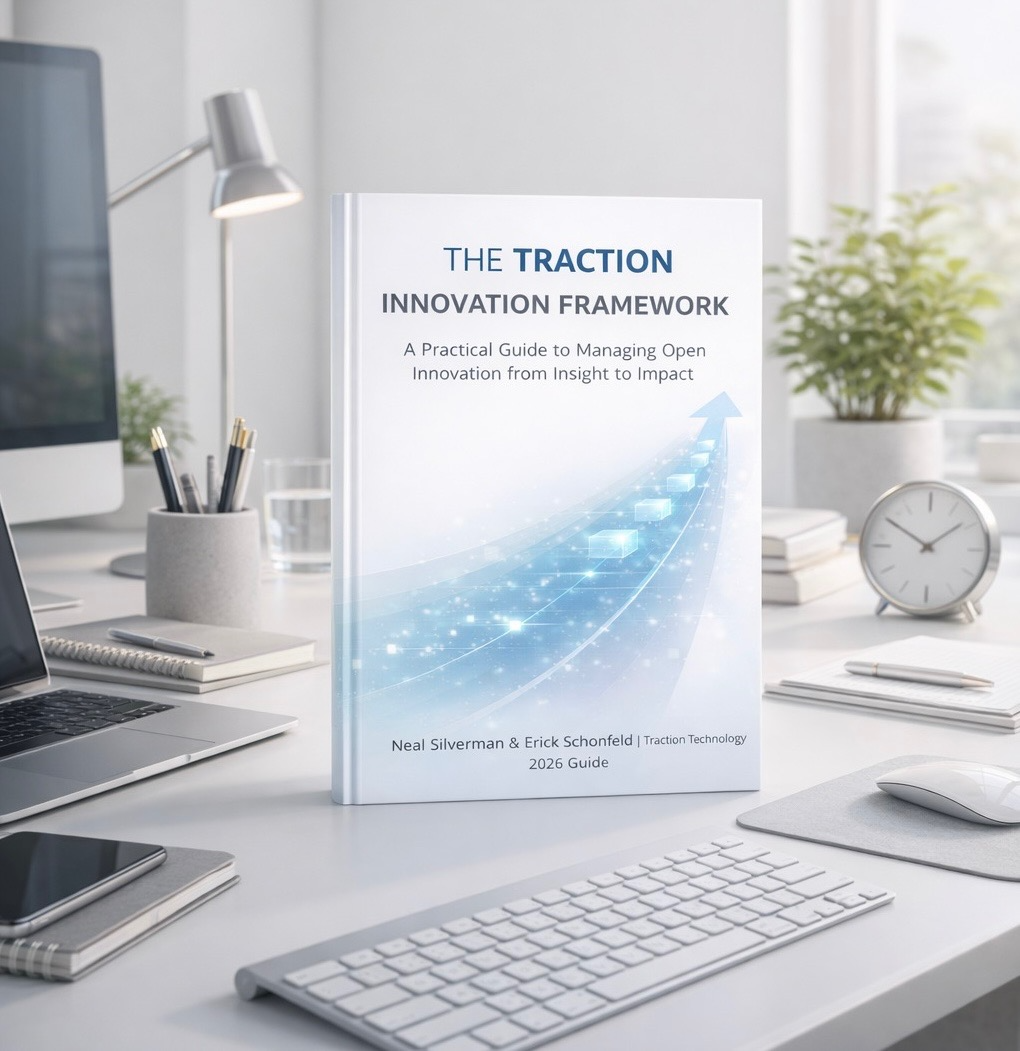
The Traction Innovation Framework™ is an eight-stage decision-driven framework designed specifically for enterprise innovation teams managing the full lifecycle from market intelligence to scale.
The eight stages:
- Market and Trend Intelligence — Where should we focus? AI-powered monitoring of emerging technology categories, startup funding activity, and market signals relevant to strategic priorities
- Open Challenges — Which problems should we invite external solutions for? Structured challenge design and submission management for open innovation programs
- Technology Scouting — Which external technologies should we track? Conversational AI scouting across any category, with structured vendor profiles and relevance scoring
- Idea Capture — Which ideas deserve attention? Structured intake with AI-powered deduplication and strategic alignment assessment
- Evaluation — Which options are enterprise-ready? Consistent, criteria-driven evaluation workflows that produce defensible decisions and documented rationale
- RFIs — Which partners are viable? Lightweight request-for-information processes that surface commercial and technical readiness before pilot commitment
- Pilots — Should we scale or stop? Governed pilot management with defined KPIs, milestone tracking, stall detection, and structured outcome capture
- Scale — How do we operationalize success? Portfolio integration and institutional memory that makes every completed pilot smarter for the next one
Each stage answers a specific question. Each decision builds on the last. Together they form a decision spine that turns innovation from episodic experimentation into a repeatable, defensible operating model.
👉 Download the Traction Innovation Framework guide free →
How to Choose the Right Framework for Your Organization
No single framework is right for every organization. The right choice depends on where your program currently breaks down.
If your problem is too many ideas and not enough evaluation structure — the priority is a decision-based evaluation framework with consistent criteria. Design Thinking and Lean Startup can help generate ideas but won't solve an evaluation backlog.
If your problem is pilots that never reach a decision — the priority is governance. Stage-Gate's decision gate logic applied to your pilot workflow will force the explicit go or no-go decisions that prevent pilot purgatory.
If your problem is not finding the right technologies — the priority is external sourcing infrastructure. Open Innovation and AI-powered technology scouting address the sourcing problem that no internal framework can solve alone.
If your problem is portfolio visibility and ROI reporting — the priority is consistent outcome capture. Three Horizons can help with allocation strategy but won't solve a data capture problem.
If your problem is all of the above — which is the situation most enterprise innovation teams are actually in — the answer is an end-to-end framework that connects all stages in a single system with consistent data capture throughout.
The Role of AI in Modern Innovation Management Frameworks
AI does not replace an innovation management framework. It amplifies one.
Applied inside a structured framework, AI accelerates the work at every stage:
- At the market intelligence stage, AI monitors the global technology landscape continuously — surfacing signals no manual process could cover
- At the scouting stage, AI enables conversational vendor discovery that produces structured shortlists in minutes rather than weeks
- At the evaluation stage, AI generates company snapshots and trend reports that reduce research overhead without sacrificing rigor
- At the idea stage, AI detects duplicates, surfaces similar prior evaluations, and validates ideas against external market signals before resources are committed
- At the pilot stage, AI monitors activity signals and flags stalls before they become failures
According to Gartner's 2026 research, organizations that proactively use AI to spot emerging trends are 2x more likely to have high innovation performance. That multiplier is only available to organizations that have a framework structured enough to direct AI toward the right decisions at the right stages.
Frequently Asked Questions
What is an innovation management framework?
An innovation management framework is a structured system that guides how an organization identifies opportunities, evaluates options, governs decisions, and moves from early-stage ideas and technologies through pilots to scaled outcomes — consistently, repeatably, and with measurable results. It is the operating model that connects the creative side of innovation to the execution side.
What is the difference between an innovation framework and an innovation process?
A process describes the activities teams perform. A framework defines the decisions teams make — what question each stage answers, what evidence is required to advance, and what happens when an initiative doesn't meet the criteria to proceed. The distinction matters because activity without decision structure produces output without direction.
What are the most widely used innovation management frameworks?
The most widely used frameworks include Stage-Gate (governance and decision gates), Design Thinking (user-centered ideation and validation), Lean Startup (minimum viable product and build-measure-learn cycles), Open Innovation (external sourcing and partner engagement), McKinsey's Three Horizons (portfolio allocation across time horizons), and Agile (iterative execution). Each addresses a specific part of the innovation challenge. Enterprise teams typically need an end-to-end framework that connects all stages rather than a single methodological approach.
What makes an innovation management framework effective?
Effective innovation management frameworks share five characteristics: they are organized around decisions rather than activities, they have explicit governance at every stage transition, they capture institutional memory as a workflow output rather than a documentation task, they connect external technology intelligence to internal evaluation and execution, and they produce measurable portfolio-level outcomes that justify program investment.
How does AI fit into an innovation management framework?
AI amplifies a structured framework at every stage — monitoring technology landscapes continuously, enabling conversational vendor discovery, generating evaluation summaries, detecting duplicate evaluations, validating ideas against external signals, and flagging pilot risks before they become failures. AI without a framework produces faster noise. AI inside a framework produces faster, better decisions.
How does the Traction Innovation Framework differ from other approaches?
The Traction Innovation Framework is an eight-stage, decision-driven operating model designed specifically for enterprise innovation teams. Unlike single-methodology frameworks that address one part of the innovation lifecycle, it connects market intelligence, open innovation, technology scouting, idea management, evaluation, and pilot governance in a single system with AI-powered decision support and institutional memory built in. It is the framework that runs inside the Traction platform.
How long does it take to implement an innovation management framework?
Implementation timeline depends on program maturity and organizational complexity. Teams using a purpose-built platform like Traction can be productive from the first evaluation — there is no lengthy setup project or data migration requirement. The institutional memory that makes the framework most valuable starts accumulating from the first initiative that runs inside it.
Explore the Traction Innovation Framework Series
Each post below goes deeper on a specific element of innovation management framework design:
- How Leading Teams Structure Innovation Decisions — and Why It Matters
- How to Design Innovation Decision Gates That Actually Work
- From Pilots to Performance: Why Innovation Needs an Operating Model
- Why Judgment Alone Doesn't Scale: The Case for Consistent Innovation Evaluation
- Decision Gates vs. Innovation Theater: How High-Performing Teams Turn Pilots Into Decisions
- The Hidden Innovation Bottleneck: Idea Submission Without Context
- The Technology Readiness Gap: Why Most Innovation Pilots Fail Before They Reach Production
- Readiness Is Not Binary: Why "Too Early" Is the Wrong Answer in Innovation
- From Scouting to Scale: How Innovation Teams Evaluate Emerging Technologies in 2026
Related Reading
- What Is Innovation Management? A Practical Definition for Enterprise Teams
- Why Pilot Management Software Is the Missing Link in Innovation Execution
- What Is Open Innovation? A Practical Guide for Enterprise Teams
- How AI Is Transforming Technology Scouting: A Practical Guide for Enterprise Teams
- Traction Technology Featured in Gartner's 2026 Report on AI-Enabled Innovation Management Platforms
About Traction Technology
Traction Technology is an AI-powered innovation management software platform trusted by Fortune 500 enterprise innovation teams including Armstrong, Bechtel, Ford, GSK, Kyndryl, Merck, and Suntory. Built on Claude (Anthropic) and AWS Bedrock with a RAG architecture, Traction manages the full innovation lifecycle — from technology scouting ( one million plus companies ) and open innovation through idea management, RFI management, and pilot management — with AI-generated Trend Reports, AI Company Snapshots, duplication detection, and decision coaching built in.
One annual subscription at $4,000 gives you the full capabilities of an enterprise innovation team — every module, every AI capability, and unlimited View-Only access for every stakeholder at no additional cost. No setup fee. No data migration charges. Featured in the Gartner Market Guide for AI-Enabled Innovation Management Platforms, February 2026. SOC 2 Type II certified.
Try Traction AI Free · View Pricing · Schedule a Demo · tractiontechnology.com
About the Author
Neal Silverman is the Co-Founder and CEO of Traction. He has spent 25 years watching large enterprises struggle to collaborate effectively with startup ecosystems — not because the technologies aren't promising, but because most startups aren't ready to meet the demands of enterprise scale. Before Traction, he spent 15 years producing the DEMO Conference for IDG, where he evaluated thousands of early-stage companies and watched the best ideas stall at the enterprise door. That problem became Traction. Today he works with innovation teams at GSK, PepsiCo, Ford, Merck, Suntory, Bechtel, USPS, and others to help them institutionalize open innovation programs and build the infrastructure to scout, evaluate, and scale emerging technologies. Connect with Neal on LinkedIn.







.webp)