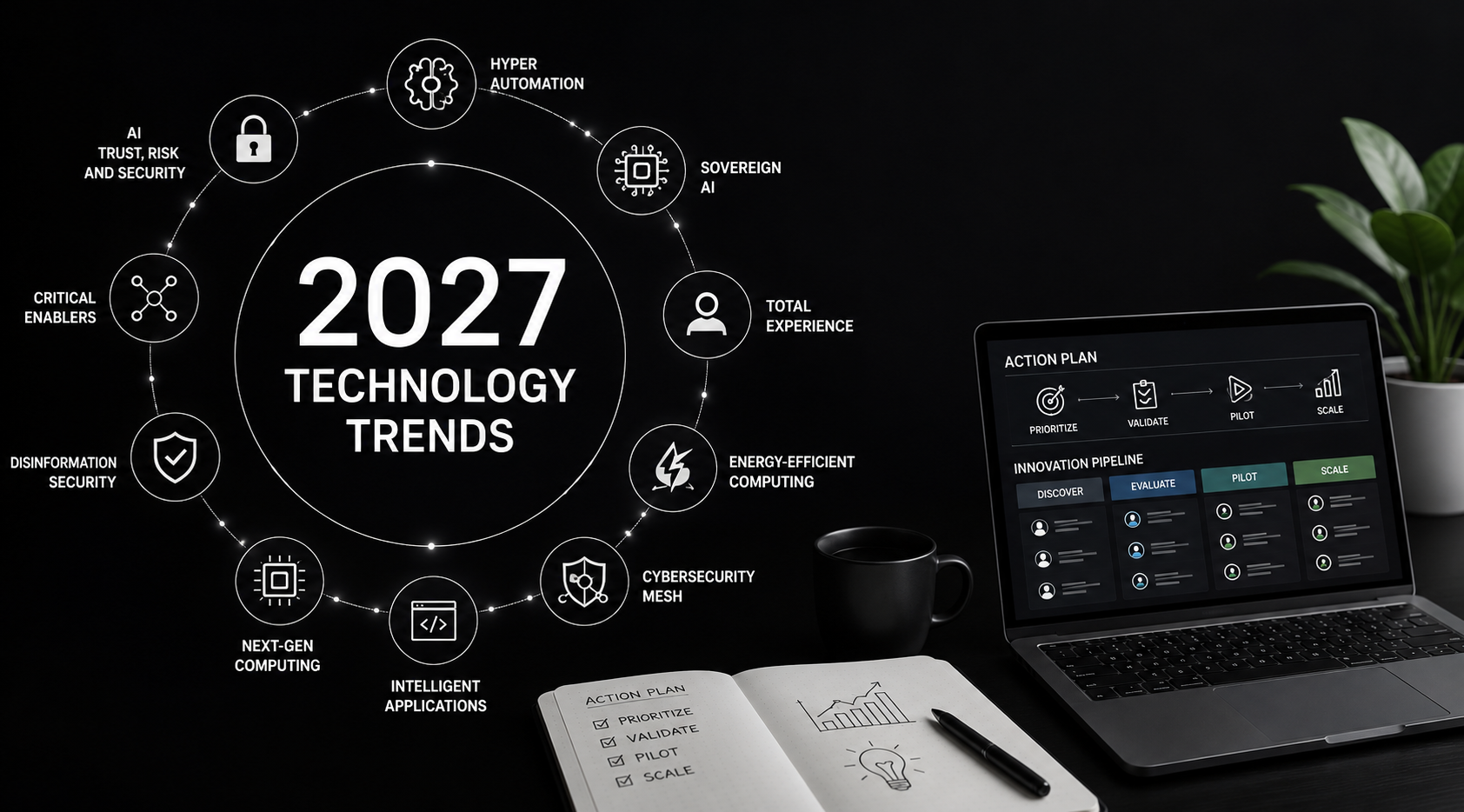
Gartner Named 10 Technology Trends for 2027. Here Is What Innovation Teams Should Do Next
By Neal Silverman
Last year, we translated Gartner’s top 10 strategic technology trends for 2026 into a concrete scouting agenda for enterprise innovation teams. Gartner has now published its 2027 list — and the shift in emphasis is striking.
Where the 2026 trends were about building and protecting digital foundations, the 2027 Gartner trends are about one thing above all: governing autonomous machines. According to Gartner, 2027 marks the move from software scarcity to software abundance — from running static code to orchestrating autonomous machine workers, sensory AI, and sovereign limits. That is a profound change in what enterprises have to evaluate, and it lands squarely in the territory innovation and IT teams are responsible for.
As Gartner Distinguished VP Analyst Gene Alvarez frames it, technology leaders must safely lead their organizations into the autonomous era, requiring an immediate C-level focus across three operational fronts. This guide translates each of Gartner’s top 10 strategic technology trends for 2027 into a concrete innovation and scouting agenda — what each trend means in practice, which vendors are worth evaluating, and where many of them have already been scored.
Traction Technology has been recognized by Gartner, including in Gartner’s February 2026 report “Innovate Faster and Better With AI-Enabled Innovation Platforms,” where Traction is featured as a named vendor with documented outcomes. And over the past year, Traction AI has scouted and scored hundreds of the exact companies delivering these 2027 trends — so for many of the trends below, the evaluation work has a running head start.
👉 Try Traction AI free — technology scouting and trend reports, no demo call required
What are Gartner’s top 10 strategic technology trends for 2027?
According to Gartner, the top 10 strategic technology trends for 2027 are organized into three themes reflecting how organizations must master the new boundaries of machine behavior:
Leverage the nontextual AI frontier — models that calculate, hear, and simulate:
- Large Quantitative Models
- Speech Reasoning Models
- World Models
Govern the autonomous agent platform — system-level control planes for trustworthy autonomy:
- AI Context Platforms
- AI Coding Agent Harness
- AI Agent Identity
- Autonomous Exposure Remediation
Architect durable agility — transitioning to sovereign, disposable, and organic environments:
- SovereignTech
- Disposable Applications
- Wetware as a Service
Gartner organizes these into “Now” (1–3 years), “Near” (3–5 years), and “Future” (5+ years) planning horizons — a useful reminder that these are not all equally urgent. What follows is what each trend means for enterprise innovation teams and which vendors are worth scouting now.
1. Large Quantitative Models
What Gartner says: Large quantitative models (LQMs) are modular, hybrid neural-network architectures built to process and analyze quantitative data, using deterministic calculations, mathematical formulas, and numerical algorithms to model complex systems. According to Gartner, by 2030 LQMs will replace LLMs in 25% of strategic forecasting and operational modeling tasks across major enterprise functions.
What it means for innovation teams: This is one of the most important trends on the list, because it addresses the single biggest weakness of general-purpose AI: large language models fail at mathematical reasoning because they guess probabilistically. For innovation teams in finance, supply chain, energy, and R&D, LQMs are a near-term scouting category — far less resource-intensive than LLMs and purpose-built for the numerical, physics-based problems that matter most in those domains.
Why it connects to Traction: We’ve already scouted and scored this category. SandboxAQ — profiled in our quantum Traction Five — builds “Large Quantitative Models” that combine AI with physics-based modeling for exactly the drug-discovery, materials, and quantitative-finance use cases Gartner describes. The category Gartner named in 2027, Traction AI scored in 2026.
Vendors worth scouting:
- SandboxAQ — Large Quantitative Models combining AI with physics-based modeling (Traction Score: 72/100)
- Physics-informed and scientific-computing AI vendors in materials, chemistry, and forecasting
- Domain-specific quantitative-modeling platforms for finance and supply chain
👉 Scout large quantitative model vendors with Traction AI
2. Speech Reasoning Models
What Gartner says: Speech reasoning models are voice AI systems that reason directly on audio — tracking context and intent across a conversation to determine what to do next, bypassing traditional text transcription. According to Gartner, by 2030 over 70% of enterprise voice interactions will be handled autonomously by speech models, up from less than 10% in 2026.
What it means for innovation teams: Voice remains the highest-volume enterprise interaction channel, and a decade of customer-support automation has failed to deliver sufficient accuracy and resolution. Speech reasoning models close that gap at scale, making complex, judgment-intensive conversations viable to automate. For innovation teams in customer experience, contact center, and operations, the scouting priority is identifying which voice-AI vendors can sustain multi-turn, judgment-heavy conversations with the governance and compliance controls enterprise voice data requires.
Why it connects to Traction: Evaluating voice-AI vendors raises exactly the questions Traction’s structured RFI and evaluation workflow is built for — consent, privacy, audit logging, and jurisdiction-specific compliance for voice data, surfaced up front rather than discovered after selection.
Vendors worth scouting:
- Voice-native reasoning platforms for enterprise contact centers
- Speech-to-speech AI vendors preserving tone, emotion, and intent
- Conversational-AI governance and voice-compliance tooling
3. World Models
What Gartner says: World models are computational systems trained on multimodal datasets to learn abstract representations of physical and virtual environments, enabling autonomous agents to simulate future states, predict outcomes, and understand the consequences of their actions before execution. According to Gartner, by 2030 40% of robotics applications will incorporate world models, up from less than 1% in 2025.
What it means for innovation teams: Language models lack a native grasp of physical reality, causality, and spatial logic; world models resolve that bottleneck with a physics-first paradigm. For innovation teams in manufacturing, logistics, autonomous systems, and defense, world models are the simulation layer that makes physical AI and robotics reliable. The scouting implication connects directly to robotics and autonomous-systems evaluation.
Why it connects to Traction: This ties to the autonomous-systems and robotics companies Traction has already scored — including Shield AI’s Hivemind autonomy and simulation stack in our Aerospace & Defense Five, and the automation companies in our manufacturing Five. Simulation and world-modeling are the connective tissue across both.
Vendors worth scouting:
- Shield AI — autonomy and simulation for GPS/comms-denied environments (Traction Score: 88/100)
- Physics-simulation and digital-twin AI platforms for robotics and AVs
- Spatial-AI and world-model foundation-model developers
👉 Scout world model and simulation vendors with Traction AI
4. AI Context Platforms
What Gartner says: AI context platforms curate, integrate, and deliver the dynamic background knowledge AI agents need to interpret inputs, make decisions, and act in alignment with business objectives — unifying scattered corporate knowledge into a machine-readable truth layer. According to Gartner, by 2027 organizations that prioritize semantics in AI-ready data will increase agentic AI accuracy by up to 80% and reduce costs by up to 60%. Gartner also notes that while 42% of enterprises plan to deploy AI agents by the end of 2026, only 22% currently capture significant value from GenAI.
What it means for innovation teams: This trend explains why so many agentic deployments stall: fragmented operational knowledge causes hallucinations and prohibitive costs. The context layer — ontology, metrics, rules, ownership, policies, and retrieval over organizational knowledge — is what grounds autonomous digital workers. For innovation teams, this is both a scouting category and an architectural lesson: the platforms you adopt should retrieve from verified, governed knowledge rather than generate from statistical patterns.
Why it connects to Traction: This is Traction’s own architecture. Traction AI is built on a RAG architecture over a verified database of more than 1 million companies — retrieval from a governed truth layer, not generation from training patterns. The reason Traction AI returns real, currently operating companies rather than hallucinated names is precisely the context-platform principle Gartner is describing. Learn more about Traction’s AI architecture →
Vendors worth scouting:
- Knowledge-graph and semantic-layer platforms (RDF, OWL, SPARQL)
- Enterprise retrieval and context-management platforms for agents
- Data-governance vendors extending to AI-ready semantic data
5. AI Coding Agent Harness
What Gartner says: An AI coding agent harness is a closed-loop system that governs autonomous developer behavior across the software development lifecycle — integrating coding platforms with enterprise context, model routing, verification gates, and feedback loops to ensure software meets safety and compliance standards. According to Gartner, by late 2026 autonomous coding agents will generate 20% of all public commits, making closed-loop harnesses mandatory to prevent critical software-delivery quality failures.
What it means for innovation teams: Coding agents are shifting from passive assistants to autonomous systems that do software production work — but scaling code generation without scaling validation shifts the bottleneck to proving changes are safe and maintainable. For innovation and platform teams, the scouting priority is the governance layer: harnesses, verification gates, and model routing that keep autonomous code generation from compiling massive technical debt.
Why it connects to Traction: This is the agentic-governance theme Traction has covered extensively — see The State of AI Governance & Security 2026–2027 and our AI Governance Five. Governing what autonomous agents produce is exactly the control-plane problem those companies address.
Vendors worth scouting:
- AI coding-agent and autonomous-engineering platforms with verification gates
- Code-security and software-supply-chain scanning for agent-generated code
- Model-routing and developer-governance tooling
6. AI Agent Identity
What Gartner says: AI agent identity is a unique digital representation that governs autonomous digital workers — correlating computational elements like model weights, prompts, and credentials with runtime behaviors to establish continuous trust and human accountability. According to Gartner, by 2028 25% of enterprise security breaches will trace back to AI agent abuse due to unmanaged machine privileges and legacy credential practices, and organizations that don’t resolve these identity challenges could see over half of their enterprise AI initiatives halt entirely.
What it means for innovation teams: This is the single most urgent governance trend on the list. Existing identity and access models were designed for humans and static services; agents need dynamic, least-privilege, auditable identity — an unsolved design problem driving rapid market consolidation as security vendors acquire specialized startups. For any innovation team deploying agents, agent identity is a mandatory evaluation criterion, not an optional one.
Why it connects to Traction: Traction has scored this category directly. The companies in our AI Governance & Model Security Five — Credo AI’s Agent Governor, Arthur’s agent discovery and runtime security — address exactly the agent-identity and accountability problem Gartner flags. This is the fastest-moving sub-segment in AI security, and the evaluation groundwork is already done.
Vendors worth scouting:
- Credo AI — AI governance with purpose-built agentic risk and runtime enforcement (Traction Score: 82/100)
- Arthur — agent discovery and runtime security (Traction Score: 72/100)
- Non-human identity and machine-credential management platforms
👉 Scout AI agent identity and governance vendors with Traction AI
7. Autonomous Exposure Remediation
What Gartner says: Autonomous exposure remediation uses AI and automation to find, prioritize, and fix security vulnerabilities across the enterprise digital estate — automatically deploying patches into production and initiating testing loops to safely roll back failed deployments. According to Gartner, by 2031 organizations deploying it will reduce their average vulnerability containment window from weeks to within 48 hours, down from an average 50-day exposure window today.
What it means for innovation teams: The traditional defensive process is broken — slow, manual validation leaves vulnerabilities unpatched for weeks. Autonomous remediation replaces that with machine-speed defense. For innovation and security teams, this is an active scouting category where the evaluation must weigh automation capability against the governance needed to trust autonomous patching in production.
Why it connects to Traction: This maps to the security companies Traction has scored in our Cybersecurity Five and the model-security vendors in our AI Governance Five — including Protect AI–type offerings built for AI-era, automated security operations.
Vendors worth scouting:
- AI-driven vulnerability discovery, validation, and automated-remediation platforms
- Autonomous patch-generation and rollback tooling
- Continuous exposure-management and preemptive-security vendors
8. SovereignTech
What Gartner says: SovereignTech refers to hardware, software, databases, and AI models technically and legally architected to offer realistic exit strategies from critical providers — remaining perpetually available to prevent lock-in and secure operational continuity. According to Gartner, by 2030 over 75% of non-U.S.-based organizations will adopt digital sovereignty strategies, shifting critical workloads to reduce geopolitical and vendor lock-in risks.
What it means for innovation teams: This is the 2027 evolution of last year’s “geopatriation” trend — and it’s broadened from data residency to full technical and legal independence. Geopolitical friction, extraterritorial laws (the U.S. CLOUD Act), and regulations like DORA are making provider lock-in an existential risk. For innovation teams operating across geographies, vendor cloud architecture, exit strategies, and sovereign-deployment options are increasingly a compliance threshold in platform selection — not a preference.
Why it connects to Traction: For enterprise teams with data-residency and sovereignty requirements, these are explicit evaluation criteria to surface in a structured RFI — exactly what Traction’s vendor evaluation workflow front-loads. It also connects to the confidential-computing and data-protection vendors Traction has profiled in its security research.
Vendors worth scouting:
- Sovereign and regional cloud providers with jurisdictional data-residency guarantees
- Confidential-computing and BYOK/customer-managed-key platforms
- Portable, exit-ready architecture and multi-cloud-independence tooling
👉 Scout sovereign technology vendors with Traction AI
9. Disposable Applications
What Gartner says: Disposable applications are purpose-built software applications designed to be intentionally retired once their specific business purpose is fulfilled — enterprise-grade applications with predefined lifespans rather than permanent fixtures. According to Gartner, by 2030 widespread SaaS fatigue and AI-driven software abundance will force leading organizations to ensure 80% of new applications are disposable and easy to replace.
What it means for innovation teams: AI-powered development tools are democratizing software creation, letting teams rapidly build targeted, temporary solutions instead of accumulating permanent, costly software assets. For innovation teams, this reframes the build-versus-buy question and has direct implications for how innovation pilots and internal tools are provisioned — spin up, prove value, retire cleanly. It also strengthens the case for lean, fast pilots with clear sunset criteria.
Why it connects to Traction: The disposable-application lifecycle Gartner describes — identify need, define, build, operate, evaluate, retire — is a pilot lifecycle, and running pilots with defined success criteria and clean closure is core to Traction’s pilot management. The discipline of deciding what to continue versus retire is exactly the fund-stop-scale decision innovation teams make.
Vendors worth scouting:
- AI app-generation and “vibe coding” platforms with enterprise guardrails
- Low-code/no-code platforms built for rapid build-and-retire cycles
- Application-portfolio-governance and lifecycle-management tooling
10. Wetware as a Service
What Gartner says: Wetware as a service is an emerging operational model providing remote, cloud-based access to living or synthetic biological systems for computation — hosted organic processors that use the plasticity of biochemical networks to run complex algorithms with extreme energy efficiency. According to Gartner, by 2030 25% of enterprise organizations prioritizing specialized low-power AI will deploy biological computing to bypass traditional silicon limits.
What it means for innovation teams: This is the furthest-horizon trend on the list — a “Future” (5+ years) item. Traditional silicon can’t scale enterprise AI indefinitely given energy demands, and lab-grown biological neurons can run pattern-recognition workloads on a fraction of the power. For most innovation teams, this is a watch-and-learn category in 2027: worth monitoring and small, low-risk pilots for the most forward-leaning R&D organizations, not near-term procurement.
Why it connects to Traction: This is a textbook case for the “watch versus evaluate versus pilot” discipline — monitoring an emerging category through continuous trend intelligence so you’re ready when it matures, without over-investing early. Traction AI’s Trend Reports are built for exactly this kind of horizon-scanning.
Vendors worth scouting:
- Biocomputing and organic-processor startups offering cloud-based access
- Neuromorphic and low-power alternative-computing platforms
- Hybrid-computing orchestration across silicon, quantum, and biological substrates
How enterprise innovation teams should use this list
The Gartner Top 10 is a strategic signal, not an action plan. The signal tells you where enterprise technology investment is concentrating; converting it into advantage requires answering four questions for each trend:
Which trends map to our organization’s specific strategic priorities? Not every trend is equally relevant or equally urgent. Gartner’s own Now/Near/Future horizons are the first filter — large quantitative models, AI context platforms, and agent identity are near-term; wetware as a service is years out. Map the trends to your actual initiatives and timelines before building a scouting agenda.
Which vendors in each category are genuinely enterprise-ready? The trend list names categories, not vendors, and each category spans research-stage startups to production platforms. This is where the work compounds: for several 2027 trends — large quantitative models, agent identity, world models, autonomous remediation — Traction AI has already scouted and scored the vendors, so your evaluation starts from a qualified shortlist, not a blank page.
What would a well-designed pilot look like for the highest-priority trends? Trend awareness without a pilot pathway is just reading. The enterprises that convert the list into advantage design governed pilots with clear success criteria against the vendors that survive evaluation.
How do we capture institutional knowledge from every evaluation? Most organizations repeat evaluations they’ve already done because the findings were never captured in retrievable form. A platform that captures evaluation rationale, vendor assessments, and pilot outcomes as structured data builds compounding intelligence — every new evaluation starts from what the organization already knows.
Traction AI generates current, requirements-mapped intelligence on any of these ten vendor categories in minutes — and for many of them, has already produced scored company shortlists you can start from today.
👉 Try Traction AI free — scout any of Gartner’s 2027 trend categories now
Key takeaways
- Gartner’s top 10 strategic technology trends for 2027 are organized into three themes centered on mastering machine behavior: Leverage the nontextual AI frontier, Govern the autonomous agent platform, and Architect durable agility. The ten trends are large quantitative models, speech reasoning models, world models, AI context platforms, AI coding agent harness, AI agent identity, autonomous exposure remediation, SovereignTech, disposable applications, and wetware as a service.
- The dominant theme is governing autonomous machines. Four of the ten trends — AI context platforms, AI coding agent harness, AI agent identity, and autonomous exposure remediation — are about the control planes needed for trustworthy autonomy.
- According to Gartner, by 2028 25% of enterprise security breaches will trace back to AI agent abuse, and by 2030 LQMs will replace LLMs in 25% of strategic forecasting tasks — two of the most consequential near-term predictions for innovation and IT teams.
- Every Gartner 2027 trend has a direct vendor-scouting implication, and for several — large quantitative models (SandboxAQ), agent identity (Credo AI, Arthur), world models (Shield AI) — Traction AI has already scouted and scored the leading vendors.
- The gap between Gartner trend awareness and competitive advantage is structured action: mapping trends to priorities and timelines, identifying enterprise-ready vendors, running governed pilots, and capturing institutional knowledge from every evaluation.
FAQ
What are Gartner’s top 10 strategic technology trends for 2027?
According to Gartner, the top 10 strategic technology trends for 2027 are: large quantitative models, speech reasoning models, world models, AI context platforms, AI coding agent harness, AI agent identity, autonomous exposure remediation, SovereignTech, disposable applications, and wetware as a service. Gartner organizes these into three themes — Leverage the nontextual AI frontier, Govern the autonomous agent platform, and Architect durable agility — reflecting the shift from running static code to orchestrating autonomous machine workers.
What is the main theme of Gartner’s 2027 technology trends?
The dominant theme is governing autonomous machines. According to Gartner, 2027 marks the shift from software scarcity to software abundance — from static code to orchestrating autonomous machine workers, sensory AI, and sovereign limits. Four of the ten trends focus specifically on the control planes required for trustworthy autonomy: AI context platforms, AI coding agent harness, AI agent identity, and autonomous exposure remediation.
What are large quantitative models (LQMs) and why does Gartner list them for 2027?
Large quantitative models are modular, hybrid neural-network architectures built for numerical reasoning — using deterministic calculations and mathematical formulas rather than the probabilistic guessing that makes LLMs fail at math. According to Gartner, by 2030 LQMs will replace LLMs in 25% of strategic forecasting and operational modeling tasks. For innovation teams in finance, supply chain, energy, and R&D, LQMs are a near-term scouting category. Traction AI has already profiled this category, including SandboxAQ, which builds Large Quantitative Models combining AI with physics-based modeling.
Why is AI agent identity one of the most urgent 2027 trends?
AI agent identity governs autonomous digital workers by correlating their computational elements and credentials with runtime behavior to establish trust and accountability. According to Gartner, by 2028 25% of enterprise security breaches will trace back to AI agent abuse due to unmanaged machine privileges, and unresolved identity challenges could halt over half of enterprise AI initiatives. Because existing identity models were built for humans, not agents, this is an unsolved problem and a mandatory evaluation criterion for any team deploying agents. Traction has scored vendors in this category, including Credo AI and Arthur.
How should enterprise innovation teams act on Gartner’s 2027 trends?
Use the list as a scouting agenda, not background reading. First, map each trend to your strategic priorities and to Gartner’s Now/Near/Future horizons — some trends (agent identity, large quantitative models) are near-term while others (wetware as a service) are years out. Then identify which vendors in each category are genuinely enterprise-ready, design governed pilots against the highest-priority trends, and capture institutional knowledge from every evaluation. For several 2027 trends, Traction AI has already produced scored vendor shortlists to start from.
How does Traction AI help enterprise teams act on Gartner’s 2027 technology trends?
Traction AI — built on Claude (Anthropic) and AWS Bedrock with a RAG architecture — generates real-time technology scouting reports and AI Company Snapshots mapping emerging vendors in any of Gartner’s 2027 trend categories to your specific requirements, scouting across a database of over 1 million verified companies. For several of the 2027 trends, Traction has already scouted and scored the leading vendors in published Traction Five reports, so teams can move from trend awareness to a qualified shortlist immediately. Try Traction AI free.
Related Reading
- Gartner Named 10 Technology Trends for 2026: What Innovation Teams Should Do Next
- The State of AI Governance & Security 2026–2027
- The State of Enterprise AI Adoption 2026–2027
- AI Governance & Model Security Companies Worth Evaluating in 2026: The Traction Five
- Quantum Companies Enterprises Should Know in 2026: The Traction Five
- Aerospace & Defense AI Companies Worth Evaluating in 2026: The Traction Five
About Traction Technology
Traction Technology is an AI-powered innovation management software platform trusted by Fortune 500 innovation teams including Armstrong, Bechtel, Ford, GSK, Kyndryl, Merck, and Suntory. Built on Claude (Anthropic) and AWS Bedrock with a RAG architecture, Traction manages the full innovation lifecycle — from technology scouting and open innovation through idea management, RFI management, and pilot management — with AI-generated Trend Reports, AI Company Snapshots, duplication detection, and decision coaching built in.
Traction AI scouts across a database of over 1 million verified companies — retrieving real, current results rather than generating hallucinated names. One annual subscription at $4,000 gives you the full capabilities of an enterprise innovation team — every module, every AI capability, and unlimited View-Only access for every stakeholder at no additional cost. No setup fee. No data migration charges. Featured in the Gartner Market Guide for AI-Enabled Innovation Management Platforms, February 2026. SOC 2 Type II certified.
Try Traction AI Free · View Pricing · Schedule a Demo · tractiontechnology.com
About the Author
Neal Silverman is the Co-Founder and CEO of Traction. He has spent 25 years watching large enterprises struggle to collaborate effectively with startup ecosystems — not because the technologies aren’t promising, but because most startups aren’t ready to meet the demands of enterprise scale. Before Traction, he spent 15 years producing the DEMO Conference for IDG, where he evaluated thousands of early-stage companies and watched the best ideas stall at the enterprise door. That problem became Traction. Today he works with innovation teams at GSK, PepsiCo, Ford, Merck, Suntory, Bechtel, USPS, and others to help them institutionalize open innovation programs and build the infrastructure to scout, evaluate, and scale emerging technologies. Connect with Neal on LinkedIn.