
The 2026 AI Innovation Playbook: From Pilots to Production
By the end of 2025, one truth became unavoidable for enterprise innovation teams:
running AI pilots is no longer the hard part — scaling them is.
Across industries, organizations launched hundreds of AI pilots in customer service, supply chain, procurement, R&D, and operations. Many of these pilots demonstrated technical promise. Far fewer made it into sustained production.
The gap isn’t caused by weak models or lack of ambition. It’s caused by how enterprises structure innovation, evaluation, and execution.
As teams head into 2026, the focus is shifting decisively from experimentation to impact.
This playbook outlines how leading organizations are moving AI from isolated pilots into repeatable, governed, enterprise-scale production systems.
Why So Many AI Pilots Stall
Most AI pilots fail for reasons that have little to do with algorithms.
Common failure patterns include:
- Pilots launched without a clearly defined business owner
- Success measured by model accuracy instead of operational impact
- Data pipelines built for experimentation, not production
- Security, compliance, and integration addressed too late
- No decision framework for what scales and what stops
In practice, many pilots succeed technically but fail organizationally. They prove that AI can work — but not that it should be deployed broadly or can be supported long-term.
This leads to what many teams now recognize as “pilot purgatory”: ongoing experimentation with no clear path to scale.
The 2026 Shift: From Experimentation to Execution
In 2026, high-performing innovation teams are changing their approach in three important ways:
- They run fewer pilots — but with higher standards.
- They design pilots with production constraints from day one.
- They apply formal decision gates to AI initiatives.
The goal is no longer to “try AI.”
It’s to build an AI-ready innovation pipeline that consistently produces deployable outcomes.
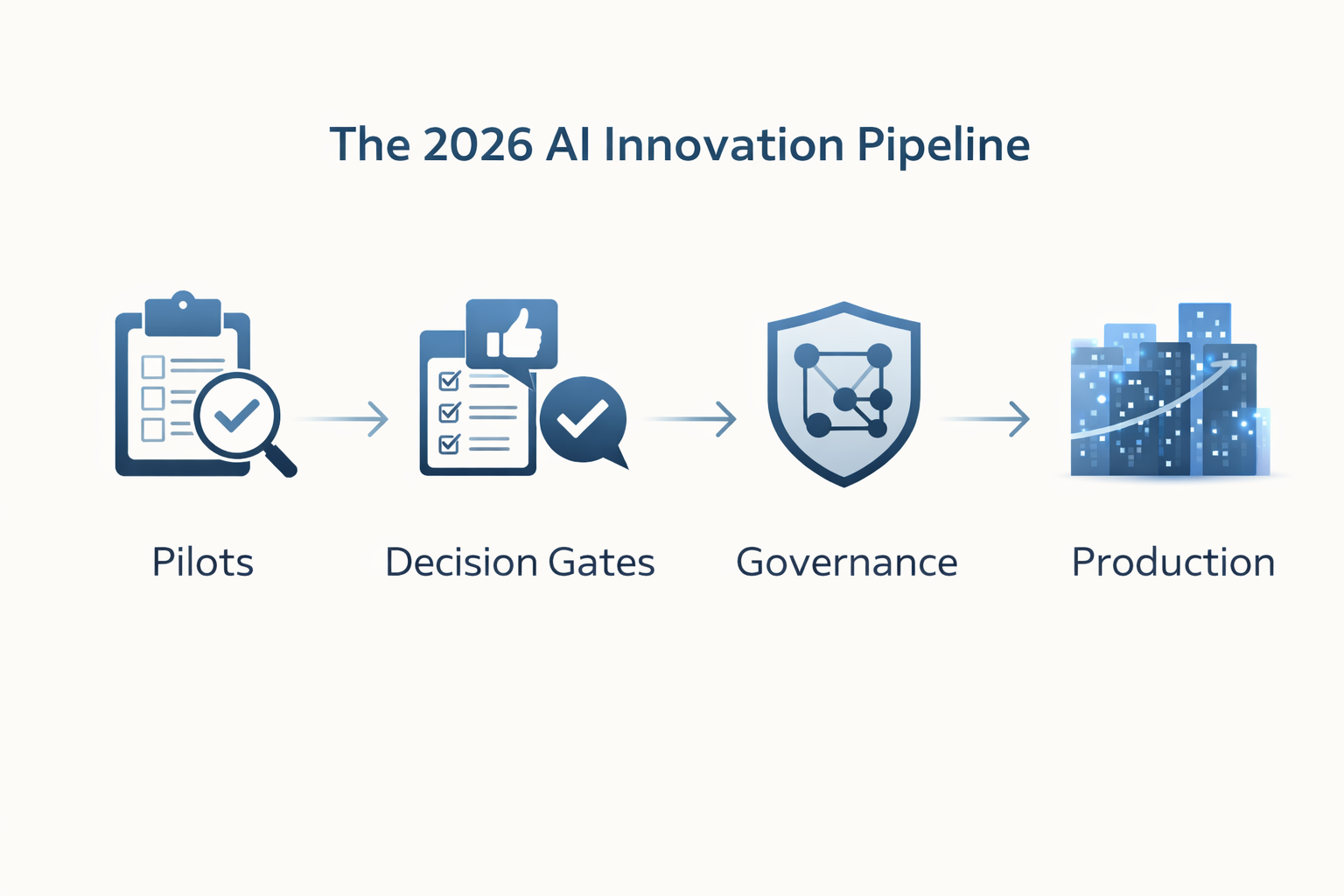
The 2026 AI Innovation Playbook
1. Start With Scalable Use Cases — Not Shiny Demos
In 2026, the most successful AI initiatives begin with business problems, not technology capabilities.
Scalable use cases typically share these traits:
- They address a repeatable operational decision or workflow
- They integrate with existing enterprise systems
- They have a clear business owner outside the innovation team
- They can expand across regions, brands, or business units
AI that improves decision quality, speed, or cost efficiency consistently outperforms novelty applications like standalone chatbots or isolated dashboards.
The key shift: innovation teams now screen ideas based on scalability potential, not excitement.
2. Bake Production Constraints Into Pilots
One of the most common reasons pilots fail to scale is that production realities are discovered too late.
In 2026, leading teams design pilots as miniature production environments, validating early:
- Data availability and reliability
- Integration complexity with core systems
- Security, privacy, and access controls
- Ongoing operational ownership
If an AI pilot cannot meet enterprise-grade requirements in a limited setting, it will not succeed at scale. Addressing these constraints early saves time, money, and organizational credibility.
3. Use Clear Decision Gates — Not Endless Experiments
AI initiatives stall when there is no clear mechanism to decide what happens next.
High-performing organizations implement explicit decision gates, asking:
- Did this pilot meet predefined success criteria?
- Is the value measurable and repeatable?
- Can it be supported operationally and financially?
- Is there executive sponsorship to scale?
Equally important, these frameworks define when to stop an initiative. Killing pilots that don’t meet standards is not failure — it is discipline.
This approach prevents pilot overload and focuses resources on initiatives with real production potential.
4. Treat Data Readiness as a First-Class Requirement
AI maturity is inseparable from data maturity.
In 2026, teams increasingly evaluate AI opportunities by first assessing:
- Data ownership and governance
- Accessibility across business units
- Data freshness and relevance
- Legal and compliance constraints
Many promising AI ideas are deprioritized not because the model won’t work, but because the data foundation isn’t ready. Organizations that address data readiness upfront move faster and scale more reliably.
5. Strengthen Governance Without Slowing Innovation
Governance has become one of the most misunderstood aspects of AI innovation.
In 2026, leading organizations treat governance as an enabler, not a blocker. Effective governance frameworks clarify:
- Where AI can be used and where it cannot
- How models are evaluated and monitored
- Who owns outcomes and risk
- How ethical, legal, and regulatory concerns are addressed
When governance is clear, teams gain confidence to scale AI responsibly — instead of hesitating indefinitely.
6. Plan for Change Management Early
Scaling AI is as much an organizational challenge as a technical one.
AI changes how decisions are made, who makes them, and how work gets done. Successful teams involve:
- Business stakeholders early
- IT, security, and legal from the start
- Operations teams before deployment
AI initiatives often fail not because the technology underperforms, but because adoption and workflow change were treated as afterthoughts.
What “Production AI” Looks Like in 2026
By the end of 2026, production AI initiatives tend to share common characteristics:
- Embedded directly into core workflows
- Owned by business units, not innovation teams
- Governed with clear standards and accountability
- Continuously monitored and improved
- Measured by business outcomes, not model accuracy
This marks the shift from AI experiments to AI capability.
Final Takeaway
2026 is the year enterprise AI grows up.
The organizations that succeed won’t be the ones that ran the most pilots — but those that built systems for consistently moving from pilot to production.
Innovation teams that apply disciplined evaluation, governance, and execution will turn AI from a promising experiment into a durable competitive advantage.
Traction Technology Supporting Innovation Frameworks in 2026
Recognized by Gartner as a leading Innovation Management Platform, Traction Technology helps drive digital transformation by streamlining the discovery and management of new technologies and emerging startups. Our platform, built for the needs of Fortune 500 companies, helps you save time, reduce risk, and accelerate your path to innovation.
Key Features & Benefits:
With our platform, innovation teams can:
- 🔍 Scout and evaluate emerging technologies in minutes
- 📊 Access AI-powered insights to make data-driven decisions
- 🤝 Collaborate seamlessly across teams and business units
- 🚀 Accelerate pilots and scale solutions that drive real business impact
👉 New: Experience Traction AI Scouting and Trend Reports with a Free Test Drive — no scheduling a demo required.
Try Traction AI for Free →
Or, if you prefer a guided experience:
Book a Personalized Demo →
Related Resources
Enterprise Use Cases Using AI Technologies
Smarter Innovation Management with AI
Top Ten Best Practices for Effective Innovation Management
Traction Technology Innovation Team Resource HUB
Awards and Industry Recognition
Recognized by Gartner as a leading Innovation Management Platform


By accelerating technology discovery and evaluation, Traction Technology delivers a faster time-to-innovation and supports revenue-generating digital transformation initiatives.






.webp)