
How Enterprises Decide Which Emerging Technologies to Say No to in 2026
In 2026, enterprise innovation teams are not short on ideas.
They are short on time, attention, and focus.
With an ever-expanding universe of emerging technologies, startups, and AI solutions, many organizations fall into the trap executives know well: chasing shiny objects. These highly visible innovations generate excitement and internal buzz — but often fail to deliver sustained business value.
The most successful enterprises are learning a critical lesson:
innovation excellence is not defined by how many opportunities you pursue, but by how effectively you decide which ones not to.
Saying “no” has become a core capability of high-performing innovation teams.
Why Saying “No” Matters More Than Ever
For years, innovation programs were measured by activity:
- Number of startups evaluated
- Number of pilots launched
- Number of technologies explored
Today, leadership expectations have changed.
Executives now ask:
- Which initiatives actually scaled?
- Which delivered measurable impact?
- Which distracted the organization from higher-value priorities?
In this environment, disciplined decision-making builds credibility, while unfocused experimentation erodes trust. The ability to say no — clearly, confidently, and consistently — is now essential.
The Hidden Cost of Chasing Shiny Objects
Shiny objects are rarely bad technologies. They are often:
- Well marketed
- Widely discussed
- Demonstrated convincingly
The problem is not curiosity — it’s lack of discipline.
Organizations that chase shiny objects often experience:
- Fragmented innovation portfolios
- Pilot overload with limited follow-through
- Teams stretched too thin
- Growing skepticism from business stakeholders
Leading innovation teams counter this by grounding decisions in clear evaluation criteria, business ownership, and measurable outcomes — not excitement alone.
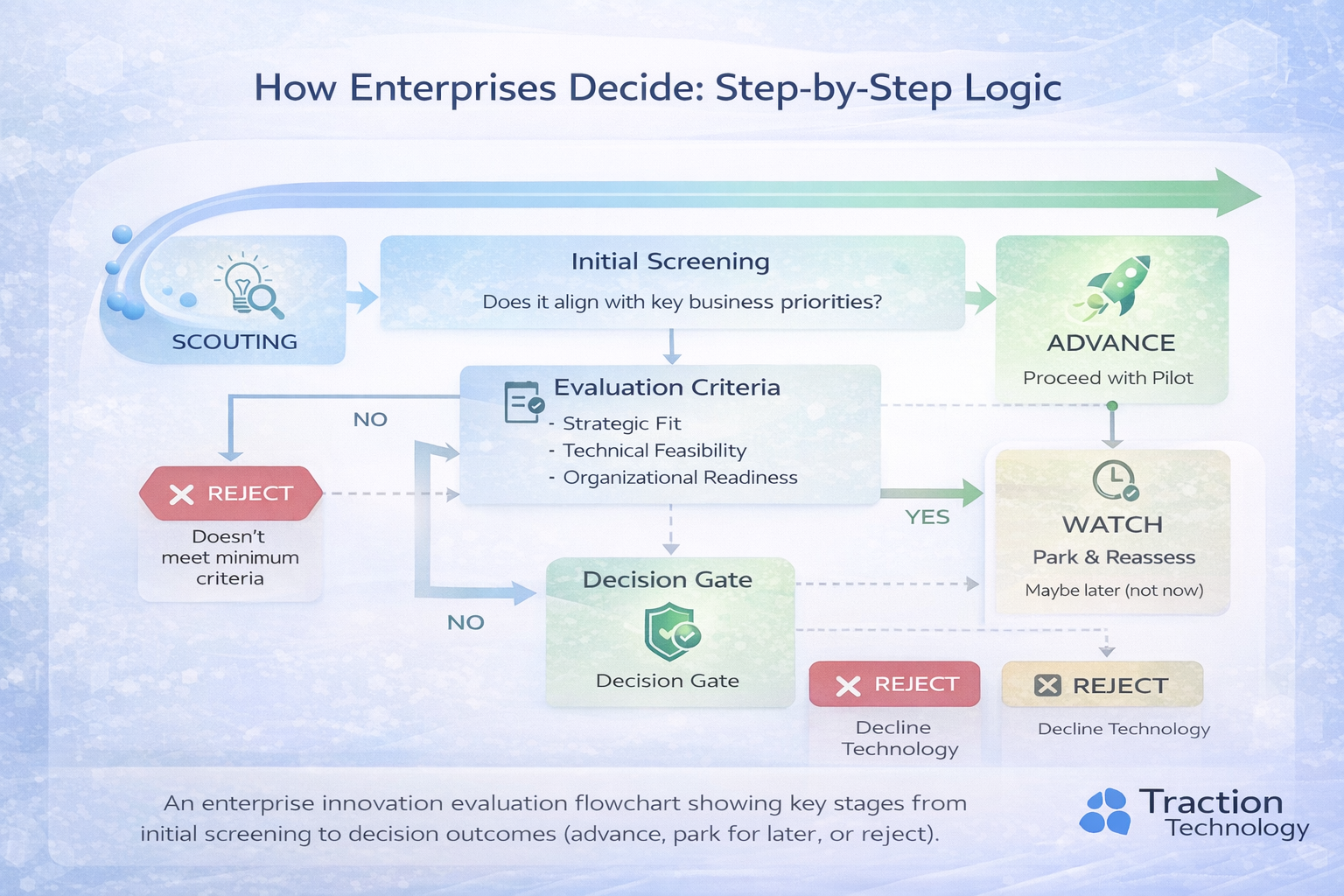
An enterprise innovation evaluation flowchart showing key stages from initial screening to decision outcomes (advance, park for later, or reject).
The 7 Most Common Reasons Enterprises Say No to Emerging Technologies
Across enterprise innovation portfolios, technologies are rarely rejected because they lack promise. More often, they fail due to fit, timing, or execution risk.
1. No Clear Business Owner
If no internal team is accountable for outcomes, even promising technologies stall. Innovation without ownership rarely survives budget cycles or leadership changes.
2. Technology Maturity Is Misaligned
Some technologies are simply too early for enterprise adoption. Others are already commoditized and no longer provide strategic differentiation. Timing matters as much as innovation.
3. Integration Complexity Is Too High
Solutions that cannot integrate cleanly with existing systems, data environments, or workflows introduce friction that quickly outweighs potential value.
4. Security, Privacy, or Data Ownership Risk
In 2026, enterprise expectations around security and data governance are non-negotiable. Startups that cannot clearly explain how data is stored, protected, and owned are often eliminated early.
5. Vendor Viability or Roadmap Risk
A compelling demo is not enough. Enterprises increasingly evaluate:
- Financial stability
- Product roadmap clarity
- Customer traction
- Long-term viability
Without confidence in the vendor’s future, scaling risk becomes unacceptable.
6. Pilot Results Do Not Justify Scale
Pilots exist to reduce uncertainty. When results fail to demonstrate impact — or cannot be scaled economically — disciplined teams move on rather than doubling down.
7. Opportunity Cost Within the Innovation Portfolio
Even strong technologies may be deprioritized if they compete with initiatives that offer clearer alignment to strategic priorities or faster time to value.
“Too Early” vs. “Wrong Fit”: A Critical Distinction
High-performing innovation teams distinguish between:
- Technologies that are too early, and
- Technologies that are fundamentally the wrong fit
This distinction matters.
“Too early” technologies may be revisited as:
- Market conditions evolve
- Regulations change
- Internal capabilities mature
“Wrong fit” technologies rarely become right without major shifts in strategy or operating model. Documenting this difference preserves learning and prevents repeated evaluation work.
How Leading Innovation Teams Turn “No” Decisions Into Learning
The most mature innovation programs do not treat rejection as wasted effort.
They:
- Capture why decisions were made
- Tag opportunities by rejection reason
- Identify patterns across evaluations
- Refine scouting and evaluation criteria over time
This creates a closed-loop learning system that improves decision quality, speed, and confidence.
Turning “No” Into Strategic Advantage
Counterintuitively, organizations that say no more effectively often move faster overall.
Why?
- Clear criteria reduce debate
- Fewer pilots create focus
- Strong governance builds executive confidence
- Resources concentrate on high-impact initiatives
In a world full of shiny objects, focus becomes a competitive advantage.
Frequently Asked Questions
Should enterprises provide feedback when rejecting startups?
When possible, yes. Clear feedback preserves relationships and improves future collaboration.
How long should a pilot run before making a decision?
Long enough to test real workflows and KPIs — but short enough to avoid sunk-cost bias.
Can rejected technologies be reconsidered later?
Absolutely. Many innovation teams maintain watch lists to reassess opportunities as conditions change.
Final Thought
Emerging technologies will continue to evolve rapidly in 2026. But organizations that succeed will not be those that chase every trend or shiny object.
They will be the ones that make disciplined, transparent, and repeatable decisions — including the decision to say no.
Saying no is not a failure of innovation.
It is what makes innovation scalable.
Stop Chasing:Technology Scouting with Traction Technology
Recognized by Gartner as a leading Innovation Management Platform, Traction Technology helps drive digital transformation by streamlining the discovery and management of new technologies and emerging startups. Our platform, built for the needs of Fortune 500 companies, helps you save time, reduce risk, and accelerate your path to innovation.
Key Features & Benefits:
With our platform, innovation teams can:
- 🔍 Scout and evaluate emerging technologies in minutes
- 📊 Access AI-powered insights to make data-driven decisions
- 🤝 Collaborate seamlessly across teams and business units
- 🚀 Accelerate pilots and scale solutions that drive real business impact
👉 New: Experience Traction AI Scouting and Trend Reports with a Free Test Drive — no scheduling a demo required.
Try Traction AI for Free →
Or, if you prefer a guided experience:
Book a Personalized Demo →
Related Resources
Enterprise Use Cases Using AI Technologies
Smarter Innovation Management with AI
Top Ten Best Practices for Effective Innovation Management
Traction Technology Innovation Team Resource HUB
Awards and Industry Recognition
Recognized by Gartner as a leading Innovation Management Platform

See what our customer are saying on G2:

“By supporting the full innovation lifecycle — from discovery through execution — Traction Technology helps us move faster and more confidently from insight to impact.”— CIO, Fortune 100 company








.webp)