
AI Use Cases That Can (and Will) Fix the Christmas Returns Supply Chain Problem
Christmas doesn’t end at the tree.
For retailers and supply-chain teams, it ends weeks later — at the return counter.
Every January, the retail industry enters “Returnuary”: a surge of unwanted gifts flowing back through stores, warehouses, and shipping networks. What starts as holiday goodwill quickly becomes one of retail’s largest operational and financial drains.
Returns are no longer a fringe issue. They are a core supply-chain problem — and AI is becoming one of the most effective tools to address it.
The Scale of the Return Problem
In 2025, 20%–25% of all retail sales are expected to be returned, including nearly 1 in 5 online purchases — representing close to $1 trillion in merchandise based on industry estimates.
The most commonly returned items are predictable:
- Clothing and shoes (fit and size issues)
- Accessories (easy gifts, easy misses)
- Electronics and gadgets (duplicates, defects, or unmet expectations)
The deeper issue is what happens next.
Many returned items never make it back onto store shelves because brands lack the infrastructure to process them cost-effectively.
Returns create reverse logistics flows that are slower, more manual, and more expensive than outbound fulfillment — stressing labor, transportation, inventory visibility, and margins.
Where AI Makes a Real Difference
AI doesn’t eliminate returns — but it reduces volume, speeds processing, and improves recovery value across the supply chain.
Below are five practical AI use cases that are already delivering results, along with one leading startup in each category and why they matter.
1. AI-Driven Fit, Sizing, and Product Recommendations
Reducing returns before they happen
The number-one reason for returns remains unchanged: customers buy the wrong size or fit.
AI models trained on body data, purchase behavior, and product attributes can dramatically reduce this problem by guiding shoppers to better decisions at checkout.
Leading Startup: Bold Metrics
Why it helps:
Bold Metrics uses AI to predict accurate body measurements and recommend the correct size with minimal customer input. By reducing size-related errors — the single largest return driver — retailers see fewer unnecessary shipments, inspections, and restocking costs.
Supply-chain impact:
Fewer wrong purchases → fewer reverse shipments → lower return volumes during peak periods.
2. AI-Powered Demand and Return Forecasting
Preparing supply chains for Returnuary
Returns are seasonal, but they aren’t random.
AI can analyze historical sales, promotions, SKU-level return behavior, geography, and external signals to forecast where and when returns will spike.
Leading Startup: o9 Solutions
Why it helps:
o9’s AI-driven planning platform helps retailers forecast both forward demand and reverse logistics flows. This allows teams to proactively plan labor, warehouse capacity, and transportation before returns overwhelm the network.
Supply-chain impact:
Better forecasting → smoother operations → fewer bottlenecks and delays.
3. Automated Return Triage and Routing
Deciding what happens to a return — instantly
Not every return should follow the same path. Some should be restocked, some refurbished, others redirected to resale channels.
AI can automate these decisions at scale.
Leading Startup: Loop Returns
Why it helps:
Loop uses AI to analyze return reasons, customer behavior, and product data to automate return routing — from instant exchanges to store credit or resale workflows. This reduces manual handling and speeds resolution.
Supply-chain impact:
Faster triage → lower labor costs → improved inventory velocity.
4. Computer Vision for Inspection and Grading
Making return processing faster and more accurate
Manual inspection is one of the most expensive steps in return handling.
Computer vision models can visually inspect returned items and determine condition, defects, or resale eligibility.
Leading Startup: Instrumental
Why it helps:
Instrumental applies computer vision to identify defects and anomalies during inspection. Originally built for manufacturing, this technology translates directly to return grading, helping teams classify items faster and more consistently.
Supply-chain impact:
Automated inspection → faster throughput → reduced processing backlogs.
5. AI-Enabled Secondary Market Optimization
Recovering value from returned goods
Many returned products are perfectly usable — just not suitable for resale through primary channels.
AI can help match returned inventory to the right secondary market, channel, and price.
Leading Startup: Recurate
Why it helps:
Recurate enables brands to resell returned and excess inventory through branded resale experiences and secondary marketplaces. AI helps optimize pricing, channel selection, and recovery value.
Supply-chain impact:
Returns shift from pure cost center → partial revenue recovery engine.
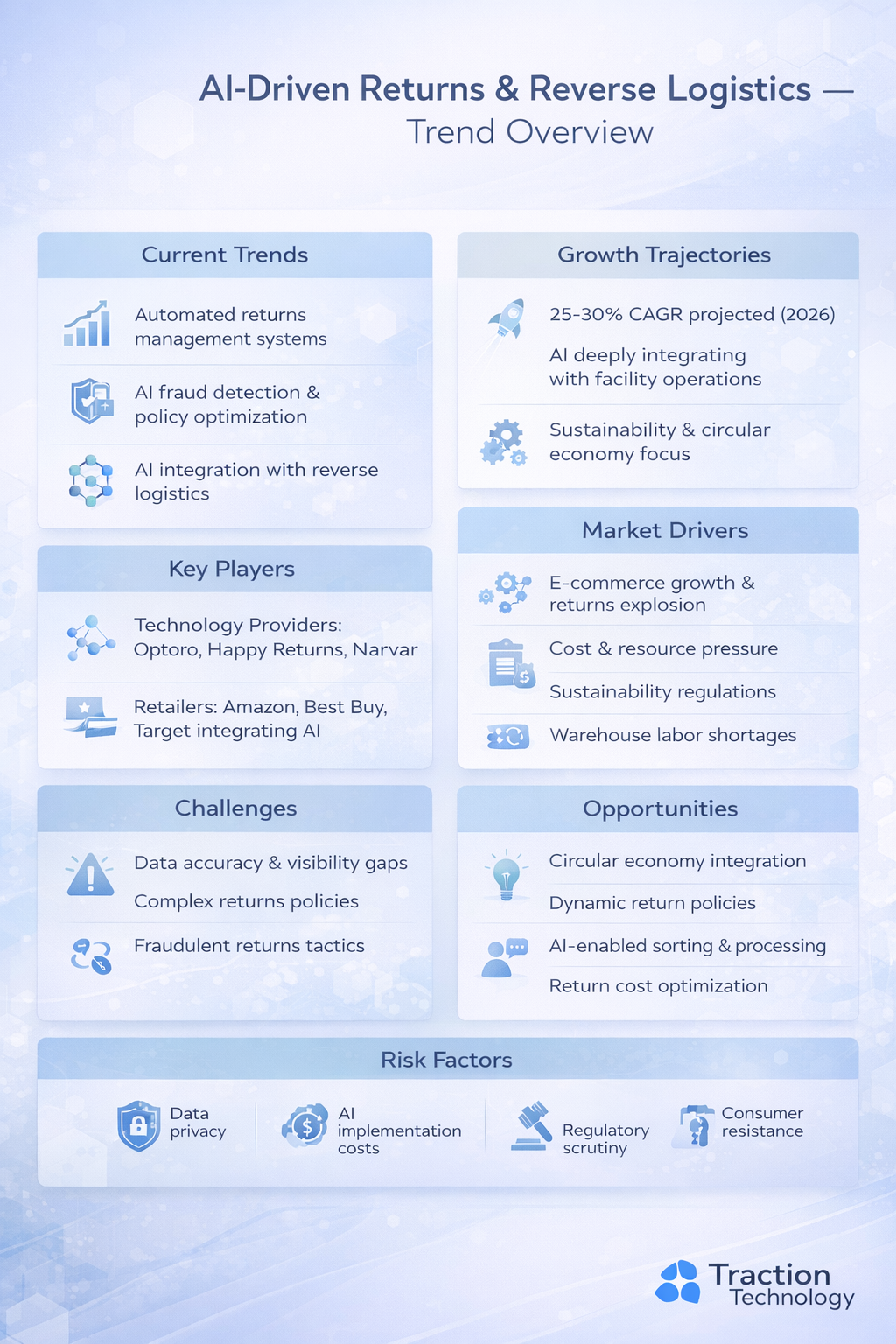
The Bigger Shift: Returns as a Strategic Data Problem
What’s changing isn’t just tooling — it’s mindset.
Leading retailers are moving from:
- Treating returns as unavoidable waste
- To treating returns as a data-rich optimization opportunity
AI enables smarter decisions before purchase, at return intake, and after processing — improving margins, sustainability, and supply-chain resilience.
And with 73% of consumers saying AI will make them less likely to return products, adoption is accelerating on both sides of the transaction.
Final Takeaway
Christmas returns expose one of retail’s most painful operational challenges — but they also highlight where AI delivers immediate, measurable value.
From fit prediction and forecasting to inspection and resale, AI is becoming a core capability for managing post-holiday supply-chain stress.
Returnuary may never disappear.
But with the right AI use cases in place, it doesn’t have to break the system.
Scouting For AI Supply Chain Technology in 2026
Recognized by Gartner as a leading Innovation Management Platform, Traction Technology helps drive digital transformation by streamlining the discovery and management of new technologies and emerging startups. Our platform, built for the needs of Fortune 500 companies, helps you save time, reduce risk, and accelerate your path to innovation.
Key Features & Benefits:
With our platform, innovation teams can:
- 🔍 Scout and evaluate emerging technologies in minutes
- 📊 Access AI-powered insights to make data-driven decisions
- 🤝 Collaborate seamlessly across teams and business units
- 🚀 Accelerate pilots and scale solutions that drive real business impact
👉 New: Experience Traction AI Scouting and Trend Reports with a Free Test Drive — no scheduling a demo required.
Try Traction AI for Free →
Or, if you prefer a guided experience:
Book a Personalized Demo →
Related Resources
Enterprise Use Cases Using AI Technologies
Smarter Innovation Management with AI
Top Ten Best Practices for Effective Innovation Management
Traction Technology Innovation Team Resource HUB
Awards and Industry Recognition
Recognized by Gartner as a leading Innovation Management Platform


By accelerating technology discovery and evaluation, Traction Technology delivers a faster time-to-innovation and supports revenue-generating digital transformation initiatives.




.webp)