
Innovation Management in Manufacturing: Why Pilots Stall — and How Leading Teams Decide What Scales
Manufacturing organizations are investing more in innovation than ever before.
AI, automation, robotics, advanced materials, digital twins, and smart factory initiatives are all moving from experimentation into core operational conversations. And yet, despite this investment, many manufacturing innovation programs struggle to move beyond pilots.
The issue is rarely technology maturity.
It’s almost always decision structure.
This post explores why innovation pilots stall in manufacturing environments — and how leading teams use a disciplined innovation management approach to decide what scales, what stops, and why.
The manufacturing innovation paradox
Manufacturers tend to be very good at execution once a decision is made.
What’s harder is the phase before scale:
- evaluating emerging technologies
- testing new operating models
- coordinating across engineering, IT, operations, procurement, and safety
- managing risk without freezing progress
As a result, many organizations accumulate:
- dozens of pilots
- disconnected proofs of concept
- initiatives that never formally end
- uncertainty about what’s actually ready to scale
This creates a perception that “innovation is slow,” when in reality decisions are unclear.
Why pilots stall in manufacturing environments
Manufacturing innovation breaks down for structural reasons that are specific to the industry.
1. Asset-heavy environments raise the cost of mistakes
Unlike software, manufacturing innovation touches physical assets, safety systems, and supply chains. That increases risk tolerance thresholds — but often without clarifying how risk should be evaluated early.
2. Pilots are launched without explicit decision criteria
Many pilots test technical feasibility but fail to define:
- what success looks like
- what would justify scale
- what would justify stopping
Without decision criteria, pilots become open-ended experiments.
3. Ownership is fragmented
Innovation teams may initiate pilots, but scale decisions involve:
- plant leadership
- operations
- IT
- procurement
- compliance
Without shared decision language, alignment happens late — if at all.
4. Past learning is lost
When pilots stall or stop, the reasoning is rarely captured in a reusable way. Teams then revisit the same ideas years later, repeating work without context.
(For more on this pattern, see:
Why innovation portfolios break down without institutional memory
Innovation management is the missing layer
In manufacturing, innovation does not fail because teams lack ideas or technologies.
It fails because innovation is treated as activity rather than a managed decision process.
Effective innovation management introduces:
- clear decision stages
- consistent evaluation criteria
- early visibility into risk
- shared understanding across functions
This allows teams to move faster without increasing exposure.
Background: What is Innovation Management? A Practical Definition for Enterprise Teams
How leading manufacturers decide what scales
High-performing manufacturing organizations tend to apply the same decision discipline, even if they don’t label it explicitly.
1. They separate exploration from commitment
Early stages focus on learning and signal detection — not approval. Later stages are explicitly about readiness for operational environments.
2. They design decision gates, not stage gates
The question isn’t “what phase is this in?”
It’s “what decision are we trying to make right now?”
See: How to design innovation decision gates that actually work
3. They assess readiness, not just performance
Technical performance alone is insufficient. Teams evaluate:
- integration complexity
- data availability
- operational ownership
- supplier maturity
- scalability constraints
This reduces late-stage surprises.
4. They treat stopping as progress
When initiatives stop, the decision — and its rationale — is captured and reused. This preserves learning and prevents future rework.
See: How innovation teams kill initiatives early without killing momentum
Applying the Traction Innovation Framework in manufacturing
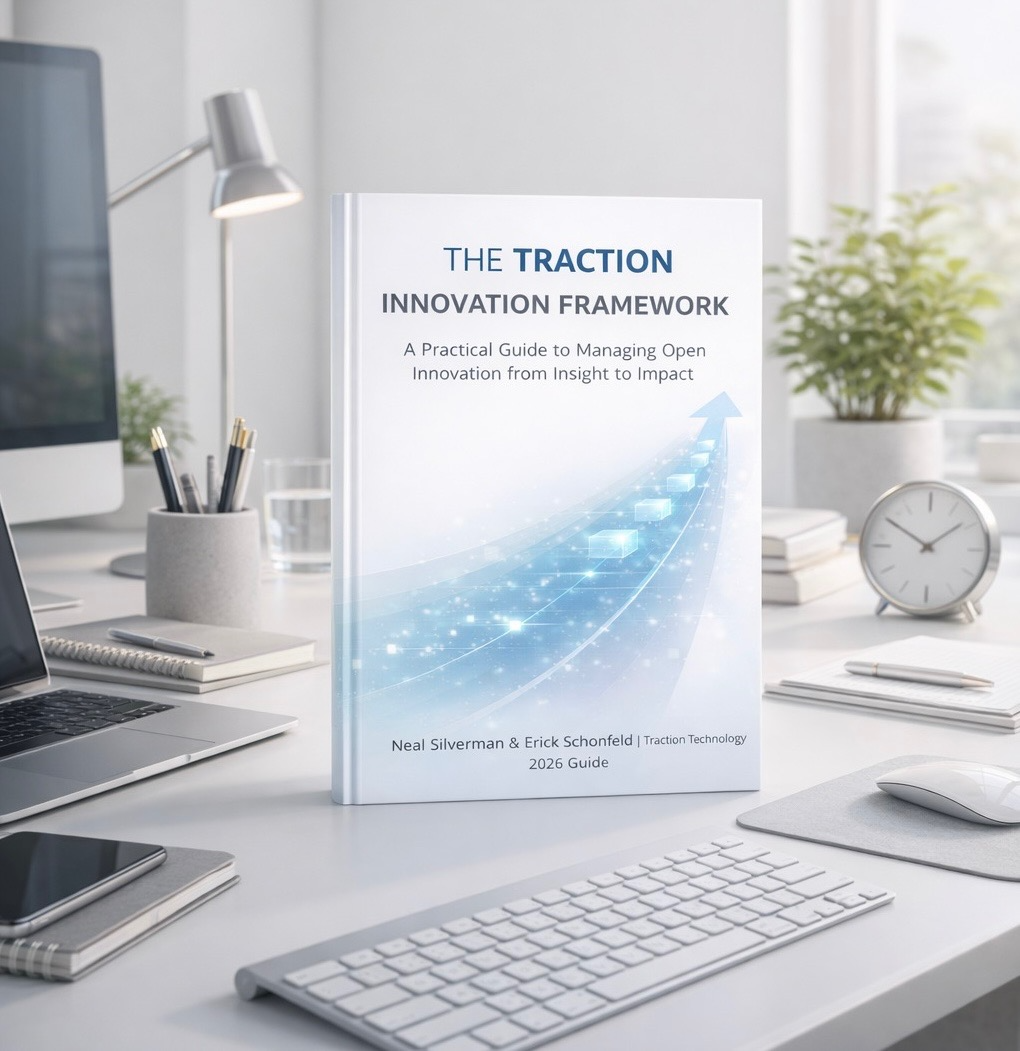
The Traction Innovation Framework provides a practical operating model for managing innovation from Market Intelligence → Scale.
In manufacturing contexts, teams apply the framework to:
- structure early technology scouting
- standardize evaluations across plants and regions
- define pilot success criteria upfront
- align IT, operations, and procurement earlier
- preserve institutional memory as teams change
The framework does not slow innovation.
It removes ambiguity — which is what actually slows decisions.
A practical framework for innovation management
The most effective innovation programs treat innovation as a lifecycle — not a set of disconnected activities.
The Traction Innovation Framework defines eight decision stages from Market Intelligence → Scale, giving teams a shared operating model for managing uncertainty.
Read the framework overview here
Or
My take
Manufacturing innovation doesn’t stall because organizations are risk-averse.
It stalls because risk is discovered too late, decisions are unclear, and learning isn’t preserved.
When innovation is managed as a decision discipline, manufacturing teams gain confidence — not just speed. And confidence is what allows organizations to scale innovation responsibly.
About Traction Technology
Traction Technology helps enterprise innovation teams bring structure and consistency to how ideas, emerging technologies, and innovation projects are evaluated, prioritized, and scaled.
Recognized by Gartner as a leading Innovation Management Platform, Traction Technology applies Traction AI to innovation decision-making — helping global enterprises reduce risk, improve alignment, and move initiatives from experimentation to execution with confidence.
Explore how Traction Technology supports enterprise innovation management →
“By accelerating technology discovery and evaluation, Traction Technology delivers a faster time-to-innovation and supports revenue-generating digital transformation initiatives.”
— Global F100 Manufacturing CIO







.webp)